
In today’s hyper-competitive electronics market, time-to-market often determines which product wins. When your competitor launches three months ahead, those 90 days can mean the difference between market leadership and playing catch-up. This reality drives demand for PCB assembly express services—rapid turnaround capabilities that compress weeks into days.
Picture this common scenario: Your procurement manager presents two quotes. One promises boards in three days, the other in three weeks. The instinct? Assume the faster option cuts corners somewhere—maybe thinner solder joints, skipped inspections, or questionable component sourcing.
This assumption made sense twenty years ago when express services truly meant rushed work and elevated defect rates. Today’s reality tells a different story. Advanced automation, refined processes, and strategic planning enable manufacturers to deliver both speed and reliability. Understanding what is PCB assembly and its critical manufacturing stages helps distinguish genuine express capability from rushed production. The key lies in understanding what separates genuine express capability from merely hurried production.
The Core Components of Express PCB Assembly
Express PCB assembly isn’t simply running production lines faster or skipping lunch breaks. It’s a comprehensive system built around eliminating wait time rather than cutting process steps.
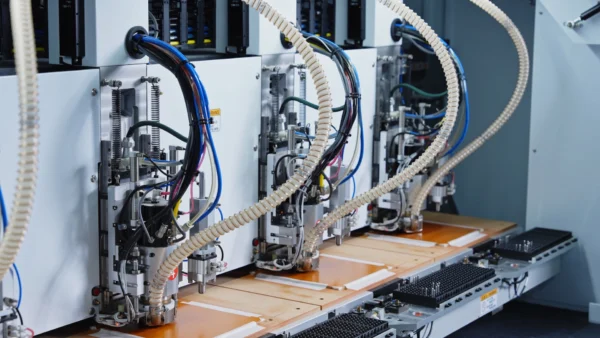
Quick-turn surface-mount technology (SMT) represents the backbone of modern express assembly. Modern SMT lines place components with precision measured in microns, operating at speeds exceeding 100,000 components per hour. What changed? The integration of automated optical inspection (AOI) directly into the placement process. Rather than quality checks happening after assembly, vision systems verify each component in real-time during placement. A misaligned IC gets corrected immediately, not discovered days later during final testing.
Through-hole assembly presents different challenges for express services. The manual labor traditionally involved—inserting leads, flipping boards, trimming excess wire—creates bottlenecks. Leading manufacturers address this through selective automation and intelligent work staging. Wave soldering systems now incorporate real-time thermal profiling, ensuring consistent joint quality regardless of production speed. For mixed-technology boards requiring both SMT and through-hole components, optimized process flows sequence operations to eliminate waiting periods between stages.
Consider a typical medical device manufacturer facing a tight project deadline. Similar challenges arise with flex PCB stiffener design where precision assembly under tight timelines requires specialized expertise. Their design combines fine-pitch SMT components for signal processing with through-hole connectors providing mechanical stability. An express assembly partner doesn’t compromise either technology—they optimize the transition between them. SMT components get placed and reflowed first, then through-hole assembly proceeds using fixtures that protect the already-populated surface. Total turnaround: five days instead of three weeks, with zero compromise in IPC-A-610 Class 3 workmanship standards.
Understanding the Speed-Quality Trade-off
When express assembly does create quality risks, the culprits are predictable: supply chain shortcuts and compressed quality assurance cycles.
The supply chain challenge manifests most acutely in component sourcing. Standard lead times allow for careful vendor verification and incoming quality inspection. Express timelines tempt suppliers to source from gray market distributors or use “equivalent” parts without proper testing. A counterfeit voltage regulator might pass cursory inspection but fail under thermal stress or exhibit higher failure rates in the field. The financial impact extends beyond rework costs—warranty claims, brand damage, and regulatory complications multiply the initial savings from expedited delivery.
Quality assurance depth presents another genuine trade-off. Comprehensive testing protocols—burn-in testing, environmental stress screening, extensive electrical validation—require time. Compress the schedule too aggressively, and these safeguards get reduced or eliminated. The result? Defects escaping into production that would have been caught with thorough testing.
Yet these risks aren’t inherent to speed itself—they stem from poor planning and inadequate processes. The solution lies in design-for-manufacturability (DFM) principles applied before production begins.
Effective DFM reviews catch issues during design that would otherwise surface during assembly. Our professional PCB design service performs comprehensive DFMEA analysis on express projects precisely because there’s no time for iteration once production starts. That unusual component footprint? Flagged before boards get fabricated. The tight component spacing requiring manual rework? Adjusted in CAD rather than on the assembly floor. At Flex Plus, our engineering team performs comprehensive DFMEA analysis on express projects precisely because there’s no time for iteration once production starts. We identify manufacturing risks upfront, recommend specific improvements, and document the rationale behind each suggestion.
Robust supplier networks provide the second pillar supporting express quality. Manufacturers maintaining strategic relationships with certified component distributors can verify authenticity and maintain traceability even under tight timelines. These partnerships enable immediate access to quality-verified inventory rather than scrambling through spot markets. When a customer needs an automotive-grade MCU for an EV application, our procurement team sources from established suppliers with full documentation trails—no gray market substitutions, no authenticity questions.
Key Factors Enabling Fast, High-Quality Production
Component availability determines express assembly feasibility more than any other single factor. A board design can be perfectly optimized for manufacturing, but if a critical IC requires a six-week lead time, express assembly remains impossible.
Strategic manufacturers address this through intelligent inventory management. Rather than stocking random components, they analyze customer design patterns and maintain inventory of commonly specified parts in popular packages. Standard resistor values, common voltage regulators, widely-used connectors—these staples enable immediate assembly start for designs built around proven components.
Efficient design libraries complement strategic stocking. When engineers design using components the manufacturer already qualifies and stocks, express assembly becomes straightforward. FlexPlus maintains comprehensive libraries of pre-qualified components across automotive, medical, and industrial applications. A new EV sensor design using parts from our automotive library can start assembly the day after design finalization—no sourcing delays, no qualification waiting periods.
Panelization optimization dramatically impacts production efficiency while maintaining quality. Instead of processing individual boards, manufacturers array multiple designs onto larger panels processed as a single unit. The result? Setup time gets amortized across multiple boards, and automated handling becomes feasible for even small quantities.
Smart panelization considers more than just fitting rectangles onto panels. Thermal profiling requirements, component height variations, and testing access points all influence optimal panel layouts. A well-designed panel enables consistent reflow profiles across all boards, eliminating the edge effects that plague hastily panelized designs. For express projects, this planning happens before panel fabrication begins, ensuring the first production run succeeds rather than requiring iteration.
Advanced automation throughout manufacturing eliminates variability—the primary enemy of quality. Manual processes introduce inconsistency; one operator’s “good solder joint” differs from another’s. Automated systems apply identical process parameters to every joint, every board, every production run.
Modern SMT lines integrate multiple technologies ensuring quality at speed. Solder paste inspection systems verify precise volume and placement before component placement begins. Automated placement machines equipped with multiple vision systems validate component orientation and positioning in real-time. Reflow ovens with dozens of independently controlled zones maintain precise thermal profiles regardless of board complexity. Post-reflow AOI systems employ advanced algorithms detecting defects human inspectors might miss.

This automation doesn’t replace human expertise—it amplifies it. Skilled engineers program the equipment, interpret inspection results, and continuously optimize processes. When an AOI system flags a potential defect, experienced technicians perform rapid root cause analysis and implement corrections before the issue propagates through production.
Essential Quality Assurance Practices
The manufacturers delivering both speed and reliability maintain comprehensive quality frameworks regardless of turnaround time.
Compliance with IPC standards forms the foundation. IPC-A-610 defines acceptable workmanship for electronic assemblies, with Class 2 covering standard consumer products and Class 3 addressing high-reliability applications like medical devices and automotive systems. Express assembly doesn’t mean relaxing these standards—it means building processes ensuring compliance without iterative checking.
Industry certifications validate systematic quality management. ISO 9001 certification demonstrates comprehensive quality management systems covering everything from supplier qualification to final inspection procedures. For medical device manufacturers, ISO 13485 certification proves specialized quality frameworks addressing regulatory requirements. Automotive applications demand IATF 16949 certification, ensuring robust process controls and traceability throughout production.
These certifications aren’t decorative certificates on office walls—they represent audited, documented systems preventing quality failures. At Flex Plus, our ISO 13485 certification means every medical device assembly undergoes full traceability, comprehensive documentation, and validated processes. Express timelines don’t compromise these requirements; they’re designed into our workflows.
Advanced inspection and testing methods catch defects automation might miss. X-ray inspection reveals hidden problems—solder voids under ball grid array (BGA) components, insufficient solder penetration in through-hole joints, bridging between fine-pitch leads invisible from surface inspection. For rigid-flex and flexible PCB assemblies, specialized inspection techniques verify bend radius compliance and conductor integrity under flexing.
Electrical testing validates functionality before shipping. In-circuit testing (ICT) verifies component values and connections, catching assembly errors like swapped components or missing parts. Functional testing confirms the assembled board performs its intended purpose, catching issues beyond assembly quality—design flaws, component tolerance stack-ups, or specification misunderstandings.
Environmental compliance represents another critical quality dimension. RoHS compliance ensures assemblies meet lead-free requirements for European markets. REACH regulations address chemical substances of concern. For express assembly, managing these requirements requires established processes and qualified materials—no time exists for last-minute substitutions or compliance research.
Selecting an Express PCB Assembly Partner
Choosing the right express assembly partner determines project success more than any other decision. The wrong choice means missed deadlines, quality issues, and expensive rework. The right partner becomes an extension of your engineering team, enabling rapid iteration and reliable production.
Evaluate turnaround capabilities with specificity. “Fast” means different things to different manufacturers. One company’s “express service” might be five days, another’s three days, a third’s 24 hours for emergency requests. But raw speed numbers don’t tell the complete story—question what capabilities accompany that speed. Does express service include full electrical testing? Is AOI inspection included or optional? What component sourcing support comes standard?
At FlexPlus, our standard turnaround reaches one week, with three-day emergency capability for critical projects. But these timelines assume comprehensive services: full DFM analysis, quality component sourcing, automated assembly with AOI inspection, electrical testing, and final quality verification. We’ve found customers value predictable quality more than maximum speed—better to deliver functional boards in three days than non-functional boards in two.
Certifications reveal process maturity and quality commitment. ISO 9001 certification indicates basic quality management systems. ISO 13485 proves capability handling medical device quality requirements. IATF 16949 demonstrates automotive-grade quality frameworks. UL certification validates safety compliance. Each certification represents audited processes, documented procedures, and systematic quality management—precisely what express assembly requires.
Question potential partners about their certification scope. Does ISO 13485 certification cover flexible PCB assembly specifically, or just rigid boards? Can they demonstrate automotive certification for flex circuits in EV applications? At FlexPlus, our certifications extend specifically to flexible and rigid-flex PCB manufacturing and assembly, reflecting our 20+ years specializing in these technologies.
Quality assurance measures deserve detailed investigation. Request specifics about inspection procedures, testing protocols, and defect handling processes. What percentage of boards undergo AOI inspection? Is X-ray inspection standard for BGA components? What electrical testing comes standard versus optional upgrades?
Transparency in pricing and logistics prevents unpleasant surprises. Express assembly naturally costs more than standard service—but how much more? Are costs predictable, or do they vary widely based on design complexity? What expedite fees apply? How are component procurement costs handled for express projects?
Clear logistics processes ensure predictable delivery. What shipping options exist? How is customs clearance handled for international shipments? Are delivery dates guaranteed or merely targets? The best express partners provide comprehensive tracking, proactive communication, and documented accountability.
Mitigating Risks in Express Projects
The compressed timeline amplifies any issues—a design flaw discovered during assembly doesn’t allow time for redesign and refabrication. Strategic practices mitigate these risks.
Early design reviews provide the most powerful risk mitigation. Before committing to fabrication, comprehensive engineering review catches potential manufacturing challenges. That component with a 12-week lead time? Identified before ordering boards. The trace width requiring specialized etching? Flagged before production begins. The panel layout requiring extensive hand-assembly? Redesigned for automation compatibility.
These reviews should involve both design and manufacturing engineers. Design engineers understand functionality requirements and system integration constraints. Manufacturing engineers know process capabilities and common failure modes. Combined perspectives catch issues neither team would identify independently.
Proper change-control processes prevent chaos during compressed timelines. When changes become necessary—and they often do—documented procedures ensure all stakeholders understand implications. A component substitution affects electrical characteristics, requiring test procedure updates. A panel layout modification changes assembly fixture requirements. Systematic change control ensures these dependencies get addressed rather than discovered during production.
Pilot runs provide invaluable validation before full production commitment. Building a small quantity—perhaps 5-10 boards—enables comprehensive testing, design validation, and process optimization before manufacturing hundreds or thousands of units. Yes, pilot runs add time to the overall schedule. But they dramatically reduce risk of expensive failures during volume production.
At FlexPlus, we recommend pilot runs particularly for designs pushing technological boundaries: ultra-thin flexible circuits, complex rigid-flex stack-ups, or assemblies integrating advanced COB technology. Our pilot run process includes comprehensive electrical testing, mechanical validation, and environmental testing appropriate to the application. Better to discover a design issue with 10 boards than 10,000.
Conclusion: Engineering Partnership for Express Success
Express PCB assembly without quality compromise isn’t just possible—it’s increasingly standard among leading manufacturers. The key lies in recognizing that speed comes from excellent planning, refined processes, and strategic preparation rather than corner-cutting or rushed execution.
Success requires partnership between customers and manufacturers. Design teams providing complete, DFM-optimized designs enable efficient production. Manufacturers maintaining robust processes, comprehensive certifications, and systematic quality management deliver reliable results under tight timelines. Communication, transparency, and mutual commitment to quality create the foundation for express projects that succeed.
At Flex Plus, our 20+ years specializing in flexible and rigid-flex PCB manufacturing informs our express assembly capabilities. We’ve built our express services around the same quality frameworks and certifications supporting our standard production: ISO 9001, ISO 13485, IATF 16949, ISO 14001. Our engineering team performs the same comprehensive DFM analysis for three-day projects as three-week projects. Our automated assembly lines maintain identical quality standards regardless of turnaround time.
We view express assembly not as a premium service with relaxed standards, but as an advanced capability demanding enhanced process control and meticulous planning. When medical device manufacturers need rapid prototypes for design validation, when EV companies face tight production timelines, when consumer electronics brands respond to market opportunities—these scenarios demand both speed and uncompromising quality.
The future of electronics manufacturing belongs to companies mastering this balance. Markets move too quickly for lengthy development cycles, yet reliability requirements continue increasing. Express assembly capability transforms from luxury to necessity, and quality remains the non-negotiable requirement separating industry leaders from also-rans.
Your next project deserves both speed and excellence. The right manufacturing partner makes both possible.