
When your procurement team receives that first PCB assembly quote, you’re seeing just the tip of the iceberg. Behind those numbers lies a complex web of cost drivers that can make or break your manufacturing budget—especially when you’re scaling from prototype to high-volume production. Understanding these hidden factors isn’t just about saving money; it’s about making smarter design decisions that affect manufacturability, reliability, and time-to-market.
After two decades of manufacturing flexible and rigid-flex PCBs for automotive, medical device, and consumer electronics clients, we’ve seen how overlooked cost factors can derail even the most carefully planned budgets. Let’s pull back the curtain on what actually drives your PCB assembly costs, so you can manage your budget with confidence.
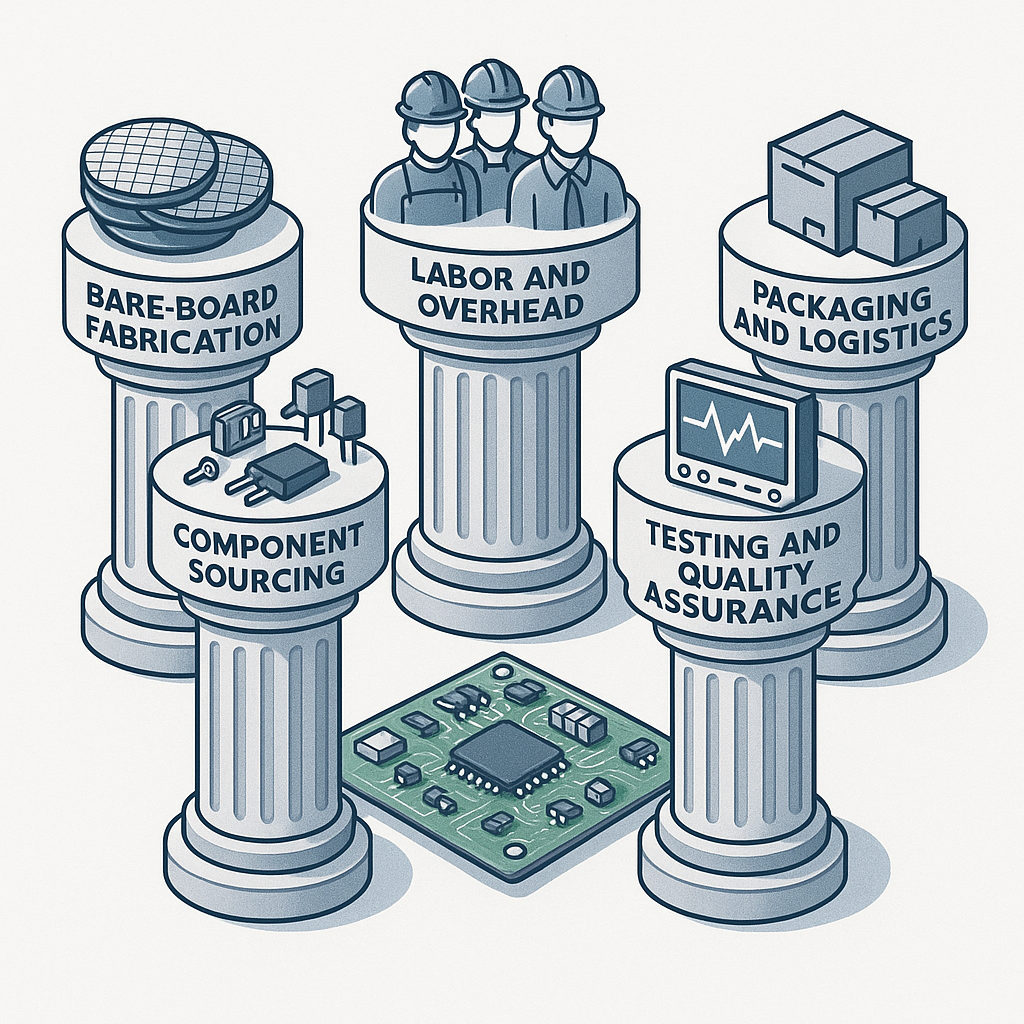
The Five Pillars of PCB Assembly Cost
Every PCB assembly project rests on five fundamental cost components. Each one carries its own complexity and potential for budget surprises.
Bare-board fabrication forms your foundation. The cost here depends heavily on your substrate choice—polyimide versus FR-4 makes a substantial difference. A medical device manufacturer switching from rigid FR-4 to flexible polyimide recently discovered their per-board material cost increased by 40%, but the elimination of connectors and reduced assembly steps ultimately delivered a 25% total cost reduction. Layer count matters enormously too. Moving from a 4-layer to an 8-layer flexible PCB doesn’t just double your cost—it can triple or quadruple it due to the exponentially more complex lamination processes and tighter process controls required.
Component sourcing typically consumes 60-70% of your total assembly budget in high-volume production. This isn’t just about the components themselves. It’s about availability, lead times, and the hidden costs of component obsolescence. An automotive supplier recently faced a three-month production delay when a single IC went end-of-life unexpectedly. The scramble to find alternatives, redesign, and requalify the board cost them far more than the component itself ever would have. Standard components from major distributors offer predictable pricing and availability. Custom or obsolete parts? That’s where budgets spiral.
Labor and overhead costs vary dramatically by manufacturing location and process complexity. Hand-assembly of through-hole components costs significantly more per board than automated SMT placement. But here’s what many engineers overlook: complex board designs with ultra-fine pitch components or dense layouts require slower machine settings and more frequent inspection stops. Your assembly house isn’t padding the quote—they’re accounting for real yield risks and the time required to maintain quality standards.
Testing and quality assurance represents another substantial cost center, especially for industries like medical devices or automotive where certification requirements are non-negotiable. Flying probe testing for low-volume runs might cost $50-100 per board. Bed-of-nails fixtures for high-volume production require upfront tooling costs of $5,000-15,000 but drop per-unit testing costs to just a few dollars. ISO 13485 or IATF 16949 certification doesn’t just add paperwork—it requires documented process controls, environmental monitoring, and traceability systems that genuinely impact manufacturing costs.
Packaging and logistics often gets forgotten until the invoice arrives. Flexible PCBs require special handling to prevent creasing or damage during transit. Moisture-sensitive components need vacuum-sealed bags with desiccants. One consumer electronics client learned this the hard way when their shipment of ultra-thin flexible circuits arrived with stress fractures from inadequate packaging. The rework cost exceeded the original manufacturing price.
Design Decisions That Multiply Costs
The choices you make at the design stage create ripple effects throughout manufacturing. Small decisions become big cost drivers at scale.
Board size affects costs in ways that aren’t always linear. A board that’s 10% larger doesn’t cost 10% more—it might cost 20-30% more because it reduces panel utilization efficiency. Standard panel sizes are typically 18″ x 24″ or similar. If your board dimensions don’t divide evenly into the panel, you’re literally throwing away material. We recently worked with an industrial controls manufacturer whose 85mm x 125mm board size wasted 18% of every panel. Adjusting the dimensions by just 5mm improved panel utilization from 82% to 94%, cutting material costs by nearly $2 per board on a 10,000-unit run.
Complexity and layer count drive costs exponentially, not linearly. Each additional layer requires another lamination cycle, more drilling operations, and tighter registration tolerances. Moving from 4 to 6 layers might increase costs by 50%. Jumping to 8 layers could double it again. But here’s the nuance: sometimes adding layers reduces overall cost. A dense 4-layer design with 3-mil traces and spaces requires expensive process controls. Spreading those traces across 6 layers with more relaxed 5-mil design rules might actually cost less to manufacture despite the extra layers.
Material selection carries long-term implications. Standard FR-4 costs a fraction of polyimide, but polyimide’s flexibility enables designs that eliminate connectors—each connector represents a potential failure point and assembly cost. For wearable devices or medical implants requiring ultra-thin profiles, specialized materials like TPU substrates become necessary. These materials cost more per square inch but enable impossible-with-rigid-PCB designs. The key is matching material capabilities to actual application requirements, not over-specifying.
Design-for-manufacturability principles separate cost-effective designs from budget-busting ones. Minimum trace widths of 2-mil instead of 5-mil don’t just increase fabrication costs—they reduce yields, requiring more stringent process controls and increasing scrap rates. Via sizes matter too. Laser-drilled microvias cost more than standard mechanical drilling. But sometimes they’re necessary for high-density interconnects. The question isn’t whether to use them, but whether your design genuinely requires that level of miniaturization.
The Hidden Impact of NRE Costs
Non-recurring engineering costs hit every new product, but many procurement teams don’t anticipate their full scope until invoices start arriving.
Engineering support and design reviews ensure your design will actually manufacture at acceptable yields. A comprehensive DFM analysis by experienced engineers catches issues before they become yield problems. That $2,000 upfront DFM review might seem expensive until you consider it prevents a $50,000 first-run failure. We regularly identify issues like inadequate copper balancing on flexible circuits, improper stiffener placement, or coverlay designs that will cause assembly headaches. Catching these issues on paper costs hundreds. Catching them after tooling costs tens of thousands.
Tooling and fixtures represent substantial upfront investments. SMT stencils for paste application cost $200-500 each. Testing fixtures range from $5,000 for simple bed-of-nails to $50,000+ for complex functional testers. Depanelization tooling for flexible circuits requires specialized dies or routers. These costs get amortized across production volume—critical information for budget planning. A $10,000 testing fixture adds $10 per board to a 1,000-unit run but only $1 per board on a 10,000-unit run.
First-article inspection and qualification ensures your design meets specifications before committing to volume production. For aerospace or medical applications, this might involve extensive reliability testing—thermal cycling, vibration testing, cross-sectioning for internal inspection. An automotive client recently invested $35,000 in qualification testing for a new sensor board. Expensive? Absolutely. But cheaper than a field failure recall that could cost millions.
Smart procurement specialists build NRE costs into project budgets from day one. They ask potential manufacturing partners for detailed NRE breakdowns during the quoting process. They understand that the lowest per-board quote isn’t always the lowest total cost when NRE factors get considered.
Panelization: The Underestimated Cost Lever
Panel utilization efficiency might sound like manufacturing minutiae, but it’s actually one of the most powerful cost levers you control through design decisions.
Optimizing panel layouts can reduce per-unit costs by 15-30% without changing anything about the board itself. The math is straightforward: if you can fit 50 boards per panel instead of 40, you’ve just cut material costs by 20%. But the implications extend beyond simple arithmetic. Better panel utilization means fewer panels to process, reducing labor costs proportionally. It means fewer material handling steps and less opportunity for damage.
Standard panels measure 18″ x 24″ (457mm x 610mm) or similar dimensions. If your board measures 100mm x 150mm, you can fit 12 boards per panel with minimal waste. But if your board measures 110mm x 160mm, you might only fit 9 boards per panel, wasting nearly 25% of your material. That small dimensional increase costs you significantly at scale.
Board orientation within the panel matters too, especially for flexible circuits. Flexible materials have grain direction that affects flexibility and reliability. Orienting boards incorrectly can create stress concentrations that lead to premature failures. We work closely with design engineers to optimize both panel utilization and mechanical performance—sometimes that means accepting slightly lower panel utilization to orient boards properly for their flexing applications.
Depanelization methods introduce their own cost considerations. V-scoring works well for rigid boards but isn’t suitable for flexible circuits. Tab-routing with mouse bites creates easy separation but requires careful planning to avoid stress on nearby components. For complex rigid-flex assemblies, custom punching dies might be necessary, adding to NRE costs but enabling clean separation in volume production.
The potential pitfalls? Misalignment issues where boards don’t separate cleanly, damaging traces near panel edges. Excessive upfront tooling costs for complex depanelization schemes that don’t justify themselves until very high volumes. The key is finding the right balance between panel efficiency and practical manufacturing constraints for your specific volume targets.
Strategies for Cost-Effective Manufacturing at Scale
Knowing the cost drivers is only valuable if you can actually do something about them. Here are proven strategies that maintain quality while managing budgets effectively.
Standard part utilization dramatically impacts both component costs and lead times. Proprietary or specialized components might offer slightly better performance specs, but standard parts from major manufacturers offer predictable pricing, availability, and often better long-term support. An aerospace contractor reduced their BOM cost by 22% by switching from custom ICs to standard alternatives that met the same performance requirements. The standard parts also had better availability, reducing supply chain risks.
Volume optimization requires honest assessment of your actual needs. Running 10,000 units to get better per-unit pricing makes sense only if you can actually use or sell those units within a reasonable timeframe. Inventory carrying costs and obsolescence risks quickly erase volume discount benefits. For many products, running 2,000-unit batches four times beats a single 10,000-unit run, especially in fast-moving technology markets where designs evolve quickly.
Manufacturing capability alignment means designing for your manufacturer’s standard processes rather than pushing their limits. If your assembler’s standard capability is 5-mil traces with 8-mil vias, designing to those specs gives you their best yields and pricing. Pushing to 3-mil traces and 6-mil vias forces them into special process controls that increase costs and reduce yields. Sometimes relaxing design rules by 20% cuts manufacturing costs by 40% with no meaningful performance impact.
Flexible PCB design considerations offer unique opportunities. The inherent flexibility eliminates connectors and cables, reducing both component costs and assembly complexity. A wearable device manufacturer reduced their assembly time by 40% by switching from a rigid board with flex cables to a fully flexible design that folded into the required shape. The flexible board cost more per square inch, but the elimination of connectors and simplified assembly delivered substantial savings.
Early manufacturing partnership catches issues while they’re still easy to fix. Engaging with your PCB manufacturer during the design phase—not after design freeze—enables optimization for manufacturability. At Flex Plus, we regularly collaborate with engineering teams to refine designs before committing to tooling. Small adjustments to pad sizes, stiffener placement, or layer stackup can significantly impact manufacturability and cost without compromising functionality.
The Value of Integrated Cost Analysis
Managing PCB assembly costs effectively requires seeing the complete picture, not just individual line items. The cheapest bare board quote doesn’t matter if it leads to assembly yield problems. The lowest component prices don’t help if those components have 20-week lead times that delay your product launch by a quarter.
Real cost optimization happens when design engineers, procurement specialists, and manufacturing partners collaborate from the start. It requires open communication about actual requirements versus nice-to-have specifications. It means understanding that sometimes spending more on fabrication reduces total assembly costs. It demands thinking beyond unit costs to total program costs including NRE, yield losses, and opportunity costs of delays.
For companies developing high-reliability flexible PCBs for automotive, medical, or aerospace applications, partnering with manufacturers who offer complete engineering support becomes crucial. You need partners who can evaluate your design holistically, identify optimization opportunities across fabrication and assembly, and provide transparent cost breakdowns that enable informed decisions.
At Flex Plus, our 20+ years of specialized experience in flexible and rigid-flex PCB manufacturing has taught us that cost optimization isn’t about cutting corners—it’s about intelligent design choices backed by deep manufacturing knowledge. Our ISO 9001, ISO 13485, and IATF 16949 certifications ensure quality standards while our end-to-end manufacturing control enables us to optimize costs across the entire process chain. From initial design consultation through volume production and full assembly services, we provide the integrated support that transforms good designs into cost-effective, manufacturable products.
The hidden factors driving your PCB assembly budget aren’t really hidden—they’re just complex. Understanding them empowers you to make better decisions that control costs without sacrificing the quality and reliability your applications demand. Your budget deserves that level of insight and partnership.