
In today’s electronics industry, speed determines survival. When a medical device manufacturer discovers a design flaw three weeks before a regulatory deadline, or when an automotive supplier needs to validate a new sensor configuration for an urgent client demo, traditional PCB lead times become project killers. This is where quick-turn PCB manufacturing changes everything—transforming what once took weeks into a matter of days, and sometimes hours.
Quick-turn PCB manufacturing refers to accelerated production cycles that deliver finished boards in 24 to 72 hours, compared to the standard 2-4 week timeline. For development teams racing against market windows or troubleshooting critical issues, this speed advantage isn’t just convenient—it’s transformative. A design engineer can submit files Monday morning and hold working prototypes in their hands by Wednesday afternoon, testing theories and iterating solutions while competitors are still waiting for their first samples to arrive.
The impact extends beyond mere convenience. Consider the automotive electronics team developing a new EV battery management system. With traditional lead times, each design iteration consumes nearly a month—submit files, wait for fabrication, test, identify issues, redesign, and repeat. Quick-turn manufacturing compresses this cycle dramatically. That same team can now complete three full design iterations in the time one traditional cycle required. The result? Faster validation, earlier problem identification, and accelerated paths to production that can mean the difference between leading a market and chasing it.
The Foundation of Speed: How Quick-Turn Capabilities Are Built
Behind every 48-hour delivery sits years of process optimization and strategic infrastructure investment. Quick-turn manufacturing isn’t simply about working faster—it’s about building systems where speed is inherent to every operation.
The foundation starts with streamlined workflows designed to eliminate bottlenecks. Traditional PCB manufacturers often operate in distinct departments with handoffs between stages—engineering receives files, transfers to CAM, which passes to imaging, and so on. Each handoff introduces delays. Quick-turn facilities restructure these workflows into integrated processes where engineering, CAM, and production teams work in coordinated parallel streams. When files arrive, multiple processes begin simultaneously rather than sequentially.
Standardized processes form the second pillar. While custom capabilities matter for specialized applications, quick-turn manufacturers establish standardized specifications for common prototype scenarios—standard material sets, proven layer stackups, optimized drill sizes. This standardization eliminates the decision-making delays that plague custom orders. An engineer selecting a 2-layer board with standard FR-4 substrate and 1oz copper taps into a pre-validated process flow that production teams can execute without additional engineering reviews.
Mature quality systems provide the confidence that makes speed possible. At facilities like FlexPlus, operating under ISO 9001, ISO 13485, and IATF 16949 certifications, quality isn’t an afterthought—it’s embedded in every rapid process. Automated optical inspection catches issues immediately, not days later. Real-time process monitoring identifies deviations before they affect multiple boards. These systems enable manufacturers to move quickly while maintaining the reliability standards that medical device manufacturers and automotive suppliers demand.
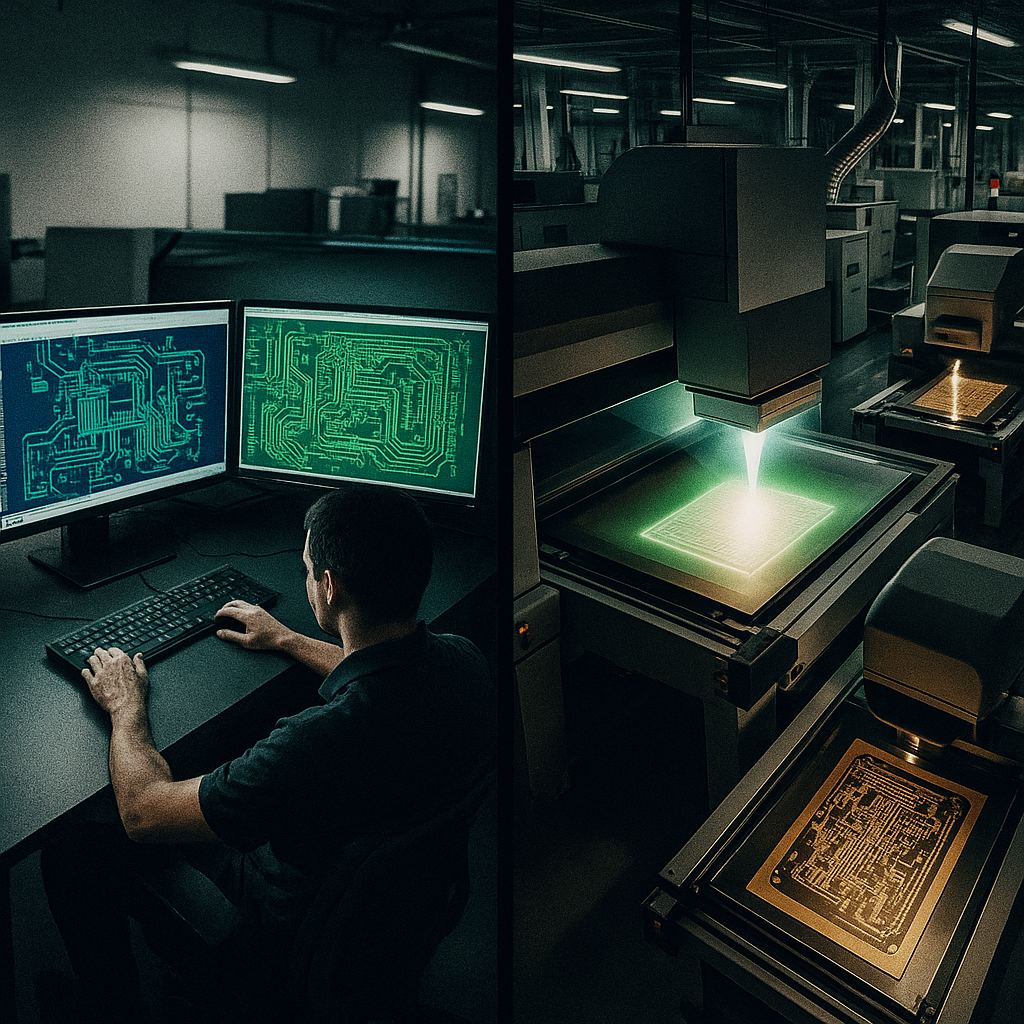
Technology infrastructure plays the decisive role. Modern quick-turn facilities invest heavily in automation—from direct imaging systems that eliminate film-based photo-tools to automated routing that completes in hours what manual operations required days to accomplish. The equipment itself runs continuously, often on three-shift schedules, ensuring that your board isn’t waiting for tomorrow’s production run to start.
Understanding Speed and Delivery in Modern PCB Production
The conversation around quick-turn manufacturing often conflates different concepts. Understanding these distinctions helps engineers make informed decisions about when and how to leverage fast production.
Prototyping and production runs serve fundamentally different purposes. Prototyping focuses on design validation—• does this circuit perform as modeled? • Do the mechanical dimensions align with enclosure requirements? • Can we identify potential manufacturing issues before committing to volume production? Quick-turn prototyping typically delivers 5-10 boards designed for functional testing and design verification. Production runs, by contrast, prioritize manufacturing efficiency and cost optimization, often running hundreds or thousands of boards with tooling and processes optimized for repeatability rather than pure speed.
This distinction matters because engineers sometimes confuse prototype capabilities with production readiness. A design that successfully produces 10 boards on a prototype run may encounter entirely different challenges at volume production. Quick-turn prototyping gives you working boards quickly, but it’s the engineering feedback during that process that prepares designs for successful scaling.
Design for Manufacturability (DFM) becomes critical in quick-turn scenarios. When lead times are measured in days rather than weeks, there’s minimal buffer for design corrections. A trace spacing violation discovered after fabrication begins can destroy your timeline advantage. Leading quick-turn manufacturers address this through proactive DFM analysis—examining your files within hours of submission and flagging potential issues before production starts. At FlexPlus, our engineers provide direct feedback on aspects like minimum feature sizes, bend radius considerations for flexible designs, and copper weight selections that might affect manufacturability. This upfront investment in design review prevents the downstream delays that undermine quick-turn benefits.
Turnkey services amplify the time-saving advantages. Traditional approaches separate PCB fabrication from assembly, requiring engineers to coordinate between multiple vendors. Turnkey quick-turn services integrate fabrication and assembly under one roof. You submit complete BOM and assembly files alongside your Gerbers, and receive fully assembled, tested boards in the same compressed timeframe. For development teams, this integration eliminates vendor coordination overhead, reduces shipping delays between fabrication and assembly, and provides single-point accountability for the complete product.
Services That Enable Rapid Development Cycles
Quick-turn PCB manufacturing encompasses a range of services engineered specifically for development speed. Understanding what’s available helps teams extract maximum value from accelerated production.
Rapid prototyping forms the core offering. Standard quick-turn services deliver 2-layer boards in 24-48 hours and 4-6 layer designs in 3-5 days. For truly urgent situations, some manufacturers offer emergency expedites—boards in customer hands within 24 hours. These capabilities serve different scenarios: the 48-hour service handles normal development cycles efficiently, while emergency expedites address crisis situations like last-minute trade show demos or urgent client presentations where delays aren’t negotiable.
Expedited assembly services extend speed benefits beyond bare boards. Quick-turn assembly typically adds 2-3 days to fabrication time, meaning you can receive fully assembled, tested PCBs in as little as 5-7 days from file submission to delivery. This integrated timeline proves invaluable when validating not just electrical performance but also component selection, mechanical fit, and thermal behavior—aspects you can only truly evaluate on assembled boards.
The process flow for fast-turn projects differs fundamentally from standard production. Files arriving in the morning immediately enter DFM analysis. Engineering feedback returns within 2-4 hours, often while you’re still at your desk to address questions. Once approved, CAM work begins immediately rather than queuing for the next available engineer. Production scheduling prioritizes quick-turn orders, ensuring your boards enter fabrication within hours of CAM completion rather than waiting for the next production batch.
Parallel processing represents perhaps the most significant efficiency gain. In traditional sequential manufacturing, each step waits for the previous to complete. Quick-turn operations execute multiple processes simultaneously. While inner layers are being imaged, outer layer artwork is already in CAM preparation. As lamination completes, drilling programs are being optimized. This parallelization compresses timelines without cutting corners on quality—you’re simply eliminating the idle waiting time that dominates traditional production schedules.
The Strategic Value for Development Teams
The benefits of quick-turn manufacturing extend far beyond simply receiving boards faster. For development teams, accelerated production cycles fundamentally transform how products evolve from concept to market.
Time-to-market acceleration provides the most obvious advantage. • In consumer electronics, a six-week head start can mean capturing holiday sales momentum or establishing market position before competitors arrive. • For medical device manufacturers, faster development cycles can shorten the runway to regulatory submissions, potentially advancing revenue timelines by quarters. • When an automotive supplier can complete validation testing three months earlier than planned, they can bid on production contracts with greater confidence and potentially secure business that would otherwise have gone to faster-moving competitors.
Increased testing opportunities deliver more subtle but equally valuable benefits. With traditional lead times, each prototype iteration costs weeks—creating pressure to get designs “perfect” before ordering boards. This pressure often produces overly cautious designs where engineers make conservative choices to avoid the cost and delay of another iteration. Quick-turn manufacturing inverts this dynamic. When the next iteration arrives in days rather than weeks, engineers can test bolder solutions, validate marginal designs, and make empirical decisions rather than theoretical assumptions. A design team might test three different filter topologies rather than committing to one based on simulation alone. This iterative freedom often produces better final designs.
Consider a wearable device manufacturer developing a new flexible PCB for a health monitoring sensor. With standard lead times, they might test one bend radius configuration, analyze the results, adjust the design, and wait another month for validation. Quick-turn flexible PCB manufacturing enables a different approach—order three variations with different bend radii, test all three within a week, and make data-driven decisions about the optimal design. This iterative capability reduces risk and often reveals solutions that theoretical analysis alone would miss.
Managing Risks While Maintaining Quality
Quick-turn manufacturing introduces trade-offs that teams must understand and manage. Speed provides immense value, but it’s not without considerations.
The primary risk involves reduced buffer time for quality verification. Standard production schedules include multiple review checkpoints where potential issues can be caught and corrected. Compressed timelines naturally reduce these buffers. A minor artwork issue that would be caught in standard review might slip through when files are moving rapidly through production. This doesn’t mean quick-turn boards are lower quality—certified manufacturers maintain rigorous standards regardless of timeline—but it does place greater responsibility on design teams to submit clean, well-validated files.
Cost represents another trade-off. Quick-turn services typically command premium pricing—often 50-100% above standard rates. For prototyping and urgent situations, this premium delivers clear value. For routine production runs, standard lead times usually make more economic sense. The key is matching service level to actual need. That critical design verification that unblocks your entire project timeline justifies premium pricing. Routine production boards that aren’t time-sensitive don’t.
Material limitations occasionally constrain quick-turn projects. Manufacturers stock standard substrate materials to enable fast turnaround, but exotic materials might require special ordering that negates speed advantages. If your design requires specific dielectric constants or unusual copper weights, verify material availability before assuming quick-turn timelines are feasible.
Risk mitigation starts with complete, accurate design files. Quick-turn manufacturers can work miracles with timing, but they can’t read minds. Submit complete Gerber files, verified drill files, and clear fabrication notes. For flexible PCB designs, specify bend requirements clearly. For rigid-flex designs, provide explicit stackup definitions. The time you invest in thorough file preparation directly translates to smoother production and faster actual delivery.
Best Practices for Maximum Speed Without Compromise
Engineers can take specific actions to optimize quick-turn manufacturing outcomes—ensuring fast delivery without sacrificing quality or functionality.
Start with comprehensive DFM review before submission. Many quick-turn manufacturers offer pre-submission DFM checks. Take advantage of them. Upload your files 12-24 hours before you actually need production to start, allowing time for engineering feedback and any necessary corrections. This proactive approach prevents the scenario where production delays occur because of issues discovered after the clock is already running.
Design to standard specifications whenever possible. Quick-turn processes are optimized around common parameters—1oz copper weights, standard trace widths and spacing, typical hole sizes. Designing within these parameters maximizes production efficiency. When you must use non-standard specifications, understand they may add time to the schedule. That 0.5oz copper weight you’re considering might require special ordering, potentially adding days to delivery.
Build strong vendor relationships. Quick-turn manufacturing works best as a partnership, not a transactional service. When you work regularly with a manufacturer like FlexPlus, engineers become familiar with your design style, understand your application requirements, and can spot potential issues more quickly. This relationship familiarity often makes the difference between smooth production and unexpected delays.
Communication proves critical in compressed timelines. When you submit files for quick-turn production, be available for questions. Provide direct contact information and respond promptly to engineering queries. A clarification question that sits in your inbox for six hours can consume 25% of a 24-hour production window. Real-time responsiveness keeps projects moving at quick-turn speeds.
Choose your quick-turn provider carefully. Not all “fast” PCB manufacturers deliver equivalent capabilities. Look for certifications relevant to your industry—ISO 13485 for medical devices, IATF 16949 for automotive applications. Verify actual in-house manufacturing capabilities rather than brokered services. Ask about typical capacity and whether your project size fits their operational sweet spot. A manufacturer whose quick-turn capacity handles 1-10 boards may struggle if you need 50 for a pilot production run.
Practical Guidance for Project Success
Managing quick-turn projects effectively requires attention to details that standard-paced development might overlook. Consider these practical tips for engineering and product teams.
Plan your design verification sequence strategically. Quick-turn capabilities enable multiple rapid iterations, but each iteration should serve a specific learning objective. • Your first prototype might validate basic electrical functionality and mechanical fit. • The second iteration might explore thermal performance and bend reliability. • The third might verify manufacturing yield at slightly higher volumes. This structured approach to learning extracts maximum value from each quick-turn cycle.
Track project metrics that matter. Lead time from submission to delivery provides one measure, but don’t ignore quality metrics. • What percentage of boards from each run meet functional specifications? • How many design iterations did the project require? • What was the total cost including all prototype runs? These metrics help you evaluate whether quick-turn approaches delivered value and inform future project planning.
Communicate timelines clearly with stakeholders. Quick-turn manufacturing creates expectations for overall project speed. Ensure stakeholders understand that while PCB fabrication might complete in 48 hours, that’s only one element of product development. Assembly, testing, validation, and iteration still require time. Set realistic expectations about overall project timelines even while leveraging quick-turn advantages for specific stages.
Consider the full development arc. Quick-turn prototyping serves initial development phases excellently, but as designs mature, you’ll eventually transition to standard production timelines for cost efficiency. Plan this transition explicitly. Your third or fourth prototype iteration might be the point where speed becomes less critical than optimizing for production cost and manufacturability at scale.
The electronics industry moves faster each year. Product lifecycles compress, market windows narrow, and competitive pressures intensify. In this environment, quick-turn PCB manufacturing isn’t a luxury—it’s a strategic capability that keeps development teams moving at market speed. When a critical design issue emerges weeks before a product launch, when a promising new approach needs validation before the next executive review, when market opportunity demands faster-than-planned execution, quick-turn capabilities provide the flexibility that transforms challenges into competitive advantages.
At FlexPlus, we’ve built our quick-turn capabilities on the foundation of 20+ years of flexible and rigid-flex PCB expertise, with in-house manufacturing control and international certifications that maintain quality while accelerating delivery. Whether you’re developing medical devices requiring ISO 13485 compliance, automotive electronics demanding IATF 16949 standards, or innovative consumer products pushing flexibility boundaries, our engineering team provides the responsive partnership that turns tight timelines into successful outcomes. The pace of innovation won’t slow—but with the right manufacturing partner, your development velocity can keep pace.