
The skies are filling with unmanned aerial vehicles—from delivery drones navigating urban corridors to agricultural UAVs monitoring vast farmlands. Behind every successful flight lies a critical component that often goes unnoticed: the printed circuit board. Drone PCB design represents one of the most challenging disciplines in electronics manufacturing, demanding an intricate balance between power delivery, weight constraints, and unwavering reliability. For engineers developing flight-critical UAV electronics, understanding this balance isn’t just technical necessity—it’s the difference between innovation that soars and prototypes that never leave the ground.
Unlike conventional electronics that operate in controlled environments, drone PCBs face extreme conditions. They must deliver stable power to multiple high-current components while weighing mere grams. They must withstand vibrations that would destroy standard circuit boards, temperature swings from ground-level heat to high-altitude cold, and electromagnetic interference from powerful motors spinning inches away. In sectors ranging from aerospace and defense to consumer electronics and precision agriculture, the PCB serves as the nervous system connecting sensors, flight controllers, power management systems, and communication modules into a cohesive, flight-worthy platform.
Power Integrity and Signal Integrity: The Foundation of Stable Flight
Power integrity forms the backbone of reliable drone operation. A drone’s electrical system must manage battery energy flowing to diverse components—each with distinct voltage and current requirements. The flight controller might demand 3.3V logic power with minimal ripple, while electronic speed controllers (ESCs) draw pulsating currents measured in dozens of amperes. GPS modules require noise-free power to maintain satellite lock, and high-resolution cameras need clean voltage rails to capture stable imagery.
Engineers face a fundamental challenge: batteries deliver variable voltage as they discharge, yet onboard electronics demand precise, stable power. This requires careful voltage regulation topology selection. Buck converters efficiently step down battery voltage for logic circuits, while low-dropout regulators (LDOs) provide ultra-clean power to sensitive analog sensors despite their lower efficiency. The PCB layout must accommodate these regulators with proper input and output capacitor placement—typically within 5mm of the regulator pins—to prevent oscillation and maintain stability during rapid load transients.
Signal integrity proves equally critical for flight-critical communications. Modern drones rely on high-speed digital interfaces connecting the flight controller to IMU sensors, GPS receivers, and telemetry radios. SPI buses operating at 10MHz or faster carry real-time attitude data from gyroscopes and accelerometers. Any signal corruption here translates directly to flight instability. I²C buses link peripheral sensors, while UART connections handle GPS and telemetry streams. Each interface requires careful impedance matching and controlled routing to prevent reflections, crosstalk, and electromagnetic interference.
The challenge intensifies with sensor placement. An IMU mounted near vibrating motors receives mechanical noise that corrupts attitude measurements. A GPS antenna positioned above high-current power traces picks up radiated emissions that degrade satellite reception. Successful drone PCB design demands meticulous planning: separating analog sensor regions from digital switching zones, creating localized ground planes for sensitive circuits, and routing high-speed signals away from noisy motor control traces. Engineers must think three-dimensionally, considering not just trace routing but also component height, cable routing paths, and potential interference sources throughout the entire UAV assembly.
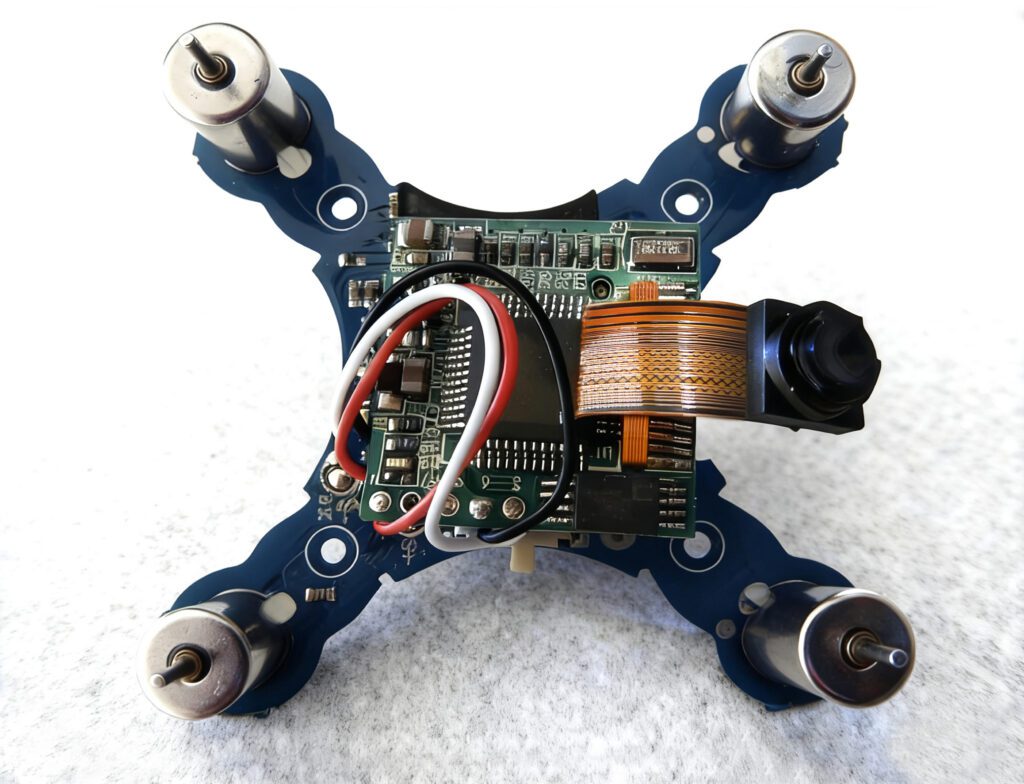
Thermal Management and Electrical Robustness Under Stress
Heat generation in compact drone electronics creates reliability challenges that extend far beyond simple component cooling. ESCs switching hundreds of watts through power MOSFETs generate intense localized heating. Voltage regulators operating near their maximum current ratings dissipate significant thermal energy. Camera processors and wireless transmission modules add their own thermal contributions—all concentrated within a PCB measuring perhaps 50mm by 50mm.
Traditional cooling solutions prove impractical for airborne applications. Heavy heatsinks contradict weight budgets. Forced-air fans consume precious battery capacity and add mechanical failure points. Instead, drone PCB designers must leverage thermal engineering through board design itself. Thermal vias connecting component pads to internal copper planes provide conductive pathways spreading heat across the board. Thick copper layers—commonly 2oz (70μm) rather than standard 1oz—increase thermal mass and improve heat dissipation. Strategic component placement positions heat-generating devices at board edges where airflow during flight naturally carries heat away.
Material selection impacts thermal performance profoundly. While FR-4 remains the standard PCB substrate for cost-sensitive applications, its thermal conductivity limits heat spreading capability. High-performance drones increasingly adopt polyimide (PI) flex circuits that combine superior thermal characteristics with mechanical flexibility. These flexible PCBs conform to curved surfaces, reduce interconnection points between rigid boards, and provide excellent thermal stability across temperature ranges from -40°C to +150°C—critical for drones operating in diverse climates.
Electrical robustness extends beyond thermal concerns to encompass mechanical and electromagnetic challenges. Drone vibrations during flight subject PCBs to accelerations that can fracture solder joints, crack boards, or cause intermittent connector failures. This demands careful attention to mechanical design: reinforced mounting points, strain relief for cables, and conformal coating protecting assembled boards from vibration-induced flexing. Component selection shifts toward mechanically robust packages—avoiding fragile ceramic capacitors in high-vibration zones, selecting connectors with positive locking mechanisms, and preferring surface-mount components with larger, more resilient solder joints.
Electromagnetic compatibility represents another critical robustness dimension. High-current motor traces create magnetic fields that induce noise in adjacent signal traces. PWM switching in ESCs generates broadband electromagnetic interference affecting GPS reception and radio communication. Proper shielding, careful ground plane design, and strategic filtering become essential. Engineers incorporate ferrite beads on power supply lines, add bypass capacitors near every integrated circuit, and create isolated ground zones for analog sensors—techniques that maintain signal integrity despite the electrically hostile environment within a flying drone.
Key Hardware Blocks: Orchestrating Flight-Critical Subsystems
A drone PCB integrates numerous specialized hardware blocks, each demanding specific design attention. At the system’s heart sits the flight controller—a microcontroller or processor running real-time control algorithms that maintain stable flight. This controller interfaces with multiple IMU sensors sampling gyroscopes and accelerometers at rates exceeding 1kHz. It processes GPS position data arriving via UART interfaces, receives pilot commands through wireless receivers, and outputs motor control signals to ESCs. The PCB must provide clean power, high-speed data paths, and adequate processing bandwidth for these real-time operations while maintaining deterministic response timing measured in microseconds.
GPS interfaces require particular care during PCB design. GPS receivers detect extraordinarily weak satellite signals—typically around -130dBm, comparable to detecting a 1-watt transmitter from beyond the moon. Any local interference overwhelms these fragile signals. Successful drone PCB designs isolate GPS modules on board sections with dedicated ground planes, filtered power supplies, and careful spacing from switching circuits. Antenna placement considerations extend beyond the PCB itself: positioning the GPS antenna with clear sky view, away from carbon fiber that blocks signals, and distant from high-power transmission antennas that desensitize the receiver.
Power management systems coordinate energy distribution from battery to all subsystems. A drone’s power budget typically allocates 70-80% to propulsion motors, with remaining capacity serving avionics, sensors, and payload. The PCB must implement multiple voltage rails—perhaps 12V for camera gimbals, 5V for peripheral sensors, and 3.3V for digital logic—while monitoring battery voltage to trigger low-power warnings. Current sensing circuits track power consumption, enabling battery state estimation and flight time prediction. Protection mechanisms including overcurrent limiting, reverse polarity protection, and short-circuit shutdown prevent catastrophic failures.
Modern drones increasingly integrate additional subsystems demanding PCB real estate and design attention. Wireless telemetry radios transmit flight data and receive configuration commands. Camera interfaces might include high-speed MIPI connections supporting 4K video streams. Obstacle avoidance sensors require PWM timing for ultrasonic distance measurements or specialized interfaces for LiDAR systems. FPV video transmitters generate high-power RF signals demanding careful shielding and filtering. Each subsystem brings unique requirements—specific connector types, particular signal integrity needs, thermal considerations—that the drone PCB designer must harmonize within the weight and size envelope.
Layout and Routing Excellence: The Art of Electrical Choreography
Effective PCB layout begins with thoughtful layer stackup selection. While two-layer boards minimize cost, they severely constrain routing flexibility and ground plane continuity—critical factors for drone electronics. Four-layer stackups provide essential benefits: dedicated power and ground planes reducing impedance and improving signal integrity, increased routing density enabling component placement optimization, and superior thermal performance through internal copper layers. High-performance drones often employ six or eight-layer stackups, dedicating layers to specific signal types—high-speed digital, analog sensors, power distribution—while maintaining uninterrupted ground planes.
Impedance control becomes critical for high-speed digital interfaces connecting flight controllers to sensors and communication modules. SPI clock lines, differential USB pairs for camera interfaces, and high-speed UART signals all require controlled impedance—typically 50Ω single-ended or 90-100Ω differential—to prevent reflections that corrupt data. Achieving this demands precise trace geometry: calculated trace width based on dielectric thickness and PCB material properties, consistent spacing from reference planes, and minimal variation along the trace length. Modern drone PCB designers leverage electromagnetic field solvers calculating impedance from stackup parameters, then translate results into specific fabrication requirements.
Component placement follows electrical partitioning principles. Sensitive analog sensors occupy board regions with clean power supplies and minimal digital switching noise. High-speed interfaces route near their associated connectors minimizing trace length. High-current paths from battery connector to ESCs follow direct routes with wide traces—often 2-3mm width handling 30-50A currents—avoiding narrow constrictions that create resistive voltage drops and heating. Power regulators position strategically: input capacitors close to battery connections, output capacitors adjacent to load circuits, and the regulator itself positioned for optimal thermal management.
Grounding strategy profoundly impacts drone PCB performance. A continuous ground plane provides low-impedance return paths for all signals, minimizes radiated emissions, and offers natural shielding between layers. However, strategic ground partitioning sometimes proves beneficial: creating isolated analog grounds for precision sensors, separating high-current motor ground returns from logic grounds, and connecting these zones at single points to prevent ground loop currents. Thermal vias stitching ground planes between layers reduce impedance and improve thermal conductivity. Engineers typically place via arrays surrounding high-current connectors and beneath heat-generating components.
Signal routing demands attention to potential interference mechanisms. Differential pairs—like USB connections or CAN bus interfaces—maintain tight coupling with matched lengths and consistent spacing. High-speed signals avoid right-angle bends that create impedance discontinuities, instead using curved routing or 45-degree corners. Sensitive analog traces route away from digital switching signals, with ground traces between them when parallel routing proves unavoidable. Clock signals receive special attention: short, direct routing with minimal vias, guard traces providing shielding, and careful attention to termination requirements.
Shielding and filtering provide final defense against electromagnetic interference. Surface-mount ferrite beads filter power supply lines, blocking high-frequency noise while passing DC power. Series resistors on digital outputs limit edge rates, reducing radiated emissions. Bypass capacitors—typically 100nF ceramic types—mount within 5mm of every IC power pin, providing local charge reservoirs that reduce power supply impedance at high frequencies. For critical circuits like GPS modules, grounded shield cans create Faraday cages blocking external interference.
Power and Energy Management: Maximizing Flight Time
Defining accurate power budgets forms the foundation of drone energy management. Engineers must account for every current draw: flight controllers typically consuming 100-500mA, GPS modules drawing 30-100mA, camera systems requiring 500mA-2A, wireless transmitters using 200-800mA during transmission bursts, and propulsion systems dominating with 10-50A continuous draw during hover. Peak current demands often exceed average consumption significantly—ESCs pulling 100A+ during aggressive maneuvers. The PCB power distribution network must handle these peaks without excessive voltage drop while maintaining efficiency during cruise conditions.
Regulator selection balances efficiency, size, and performance. Switching buck converters efficiently step down battery voltage (typically 11-16V for 3S-4S lithium polymer packs) to logic voltages, achieving 85-95% efficiency and minimizing waste heat. However, switching noise from these converters can corrupt sensitive analog measurements. Low-dropout linear regulators provide ultra-clean power for sensors despite lower efficiency—acceptable when current demands remain modest. Modern drone designs often employ hybrid approaches: switching converters for high-current digital loads, followed by LDO post-regulation for noise-sensitive analog circuits.
Protection mechanisms prevent catastrophic failures that could destroy expensive drones or create safety hazards. Overcurrent protection circuits detect excessive current draw indicating short circuits or motor faults, triggering shutdown before PCB traces overheat or battery damage occurs. Reverse polarity protection—typically implemented with series diodes or MOSFETs—prevents destruction when batteries connect incorrectly. Transient suppression devices protect against voltage spikes during motor braking or battery disconnection. These protective elements add minimal weight but provide essential safeguards for flight-critical systems.
Battery monitoring provides crucial flight time estimation and prevents damaging over-discharge. Modern drone PCBs integrate voltage sense circuits measuring individual cell voltages, current sense amplifiers tracking power consumption, and sometimes fuel gauge ICs estimating remaining capacity. This data feeds flight controllers that calculate remaining flight time, trigger return-to-home procedures when batteries reach minimum levels, and protect expensive lithium polymer packs from over-discharge damage that reduces lifespan.
Mechanical and Environmental Resilience
Material selection profoundly impacts PCB durability under flight conditions. While standard FR-4 substrates serve cost-sensitive applications, they present limitations in vibration resistance and thermal performance. Polyimide flexible PCBs offer superior mechanical properties: they withstand continuous flexing during flight vibrations, maintain electrical properties across wider temperature ranges (-40°C to +150°C), and provide excellent thermal conductivity. For specialized applications, FlexPlus’s innovative TPU circuits combine medical-grade thermoplastic polyurethane substrates with precision circuit fabrication, creating ultra-flexible PCBs ideal for conforming to curved drone surfaces or integrating into wearable drone controllers.
Conformal coating protection shields assembled PCBs from environmental hazards. Drones encounter moisture from rain or high humidity, dust particles that can cause short circuits, and temperature extremes affecting component performance. Thin polymer coatings—typically acrylic, silicone, or polyurethane formulations—provide protective barriers while adding minimal weight. These coatings prevent corrosion on exposed copper, protect solder joints from mechanical stress, and improve high-voltage breakdown resistance. Application requires careful masking of connectors and heat-sensitive components while ensuring complete coverage of circuit traces.
Enclosure design considerations extend beyond the PCB itself to housing selections. Many drone flight controllers mount in plastic or carbon fiber cases providing mechanical protection and environmental sealing. Ingress Protection (IP) ratings quantify environmental resistance: IP54 providing protection against dust and water spray, IP67 offering complete dust sealing and temporary submersion protection. For specialized applications like maritime or agricultural drones encountering harsh environments, higher protection levels become essential.
Redundancy and failsafe features provide critical safety margins for expensive UAVs or drones carrying sensitive payloads. Dual IMU sensors allow cross-checking attitude measurements, detecting failures before they cause crashes. Redundant power supplies ensure continued operation if one regulator fails. Watchdog timers reset frozen processors, while brownout detectors trigger emergency procedures during power failures. These features add complexity and cost but prove essential for applications where drone loss carries significant consequences.
Manufacturing and Testing Readiness
Designing for manufacturability ensures reliable transition from prototype to production. PCB design rules must align with manufacturer capabilities: minimum trace widths (typically 0.1-0.15mm for standard fabrication), spacing requirements between traces and pads, via sizes that remain reliably manufacturable, and copper weight selections that balance current handling with fabrication cost. FlexPlus’s advanced capabilities—supporting minimum trace width/spacing of 0.05mm/0.05mm—enable ultra-compact drone designs, but engineers must verify their chosen manufacturer supports such fine geometries before finalizing layouts.
Panelization strategies optimize production efficiency while ensuring board quality. For small drone PCBs, multiple boards panel together on larger production panels, reducing per-board handling costs. Proper panel design includes tooling holes for automated assembly, fiducial marks enabling machine vision alignment, and mouse-bite or v-score separation techniques that minimize board stress during depaneling. Engineers must consider how separation methods affect board edge quality, especially for boards mounting in tight enclosures.
Design for testability incorporates features enabling thorough post-assembly validation. Test points provide accessible locations for probing voltages and signals without requiring component removal. Built-in self-test capabilities allow flight controllers to verify sensor connectivity, motor function, and communication interfaces during power-up. Boundary scan chains (JTAG) enable comprehensive testing of digital circuits, while analog test interfaces support calibration of sensors and power supplies.
Post-assembly testing plans ensure every manufactured drone PCB meets performance requirements before flight. Automated optical inspection (AOI) verifies correct component placement and solder joint quality. In-circuit testing validates basic connectivity and component values. Functional testing applies power, loads firmware, and exercises all interfaces under realistic conditions. Environmental stress screening exposes latent defects by thermal cycling or vibration testing before delivery.
Component selection influences both manufacturability and long-term reliability. Engineers specify components with proven availability, preferring parts with multiple qualified sources over single-source exotic components. Package selections favor types suited to automated assembly—avoiding fragile packages in high-vibration zones while selecting appropriate package sizes for assembly equipment capabilities. Moisture sensitivity ratings guide storage and handling requirements, while operating temperature ratings ensure components survive environmental extremes.
Practical Design Excellence: Iterating Toward Perfection
Industry experience teaches valuable lessons for drone PCB designers. Starting with simpler designs before adding complexity allows thorough validation of core functionality—testing power distribution, basic flight control, and essential sensors before integrating advanced features. This staged approach identifies fundamental issues early when fixes prove simpler and less costly.
Simulation tools provide invaluable insights before fabrication. Power integrity simulations model voltage drop across power distribution networks under peak current conditions, identifying inadequate trace widths or problematic routing. Signal integrity simulations analyze high-speed interfaces, predicting reflections, crosstalk, and timing issues. Thermal simulations map temperature distributions, revealing hot spots requiring improved cooling. While simulations demand engineering time investment, they prevent costly respins by identifying issues before physical prototypes.
Physical measurements validate designs and guide refinements. Oscilloscopes capture actual signal integrity on manufactured boards, revealing issues that simulations missed. Thermal imaging cameras identify unexpected hot spots during operation. Current measurements verify power consumption matches predictions and identify inefficient circuits draining battery capacity. These empirical validations inform iterative improvements, transforming adequate designs into optimized solutions.
Collaboration between design and manufacturing teams proves essential. Early engagement with PCB fabricators identifies potential manufacturing challenges before layout completion. Assembly houses provide feedback on component placement optimizing automated assembly. Testing teams contribute requirements for test points and diagnostic features. This cross-functional collaboration prevents surprises during production launch and ensures smooth scaling from prototypes to volume manufacturing.
FlexPlus: Your Partner in Advanced Drone PCB Solutions
The challenges of drone PCB design demand manufacturing partners with deep expertise, advanced capabilities, and unwavering commitment to quality. FlexPlus (Xiamen) Co., Ltd brings over 20 years of specialized experience in flexible and rigid-flex PCB solutions, serving the demanding requirements of aerospace, automotive, and advanced electronics industries. Our ISO 9001, IATF 16949, and ISO 13485 certifications demonstrate compliance with the most stringent international quality standards—essential for flight-critical UAV electronics where reliability cannot be compromised.
FlexPlus’s technical capabilities directly address the unique challenges of drone PCB design. Our ultra-thin flexible PCBs—down to 25 microns with gold plating on double-sided designs—enable weight optimization critical for extending flight times. Rigid-flex PCB technology combines the reliability of rigid boards with flexible interconnections, eliminating connector weight while improving mechanical robustness against flight vibrations. For specialized applications, our innovative TPU circuit technology provides medical-grade flexibility ideal for conforming to curved drone surfaces or wearable drone control systems.
Our thermal management innovations prove particularly valuable for compact, high-performance drones. FlexPlus’s proprietary flexible heat dissipation flow channels provide breakthrough thermal solutions, reducing operating temperatures in power-intensive applications. This technology enables more aggressive component packing without compromising reliability—essential for competitive drone designs balancing capability against size and weight constraints.
Manufacturing support extends beyond fabrication to comprehensive engineering partnership. Our Design for Manufacturing (DFM) support identifies potential issues before production, reducing iteration cycles and accelerating time-to-market. Material consultation helps designers select optimal substrates balancing thermal performance, mechanical properties, and cost considerations. Direct communication with production engineers ensures technical questions receive expert responses promptly, without intermediary delays that compromise project schedules.
From rapid prototyping within one week (three days for emergency requests) through volume production supporting thousands of units monthly, FlexPlus provides scalable manufacturing capacity as drone projects mature from concepts to commercial products. Our comprehensive assembly services—including SMT placement, through-hole assembly, and complete PCBA solutions—reduce vendor management complexity while ensuring consistent quality throughout the supply chain.
As drones continue revolutionizing industries from logistics and agriculture to public safety and infrastructure inspection, the PCB technologies enabling these innovations must advance equally rapidly. FlexPlus stands ready as your manufacturing partner, combining certified quality systems, advanced technical capabilities, and two decades of flexible PCB expertise to transform your drone designs from concepts to reliable, flight-worthy realities. Together, we enable the next generation of unmanned aerial innovations that will shape our future skies.