
Every morning, millions of people strap on their fitness trackers, smartwatches, and health monitors without giving a second thought to the engineering marvel wrapped around their wrists. These devices bend with every movement, endure sweat during workouts, and withstand countless flexing cycles—yet they keep working reliably day after day. The secret behind this durability? Flexible Printed Circuit Boards, or FPCBs.
Unlike the rigid circuit boards found in desktop computers, FPCBs are the backbone of modern wearable technology. They’re thin, lightweight, and designed to bend without breaking, making them perfect for devices that need to conform to the human body. Understanding how these circuits work reveals why your fitness tracker can survive thousands of bends while still accurately tracking your heart rate and steps.
Why Wearables Need Flexibility
Traditional rigid PCBs simply won’t work in wearable devices. Imagine trying to wrap a stiff board around your wrist—it would be uncomfortable, bulky, and prone to failure. FPCBs solve this problem by offering three critical advantages that make modern wearables possible.
First, they’re incredibly lightweight. A typical FPCB weighs just a fraction of what a rigid board would, reducing the overall device weight by up to 60%. This matters tremendously when you’re wearing a device for 16 hours a day. The difference between a 30-gram and 50-gram smartwatch might seem small, but your wrist notices it immediately.
Second, FPCBs provide exceptional mechanical resilience. These circuits can withstand tens of thousands of bending cycles without electrical failure. At Flex Plus, our testing shows that properly designed FPCBs can endure over 100,000 flex cycles—far exceeding the typical lifespan requirements of consumer wearables. This resilience comes from careful material selection and design principles that we’ll explore shortly.
Third, FPCBs conform naturally to body contours. Whether it’s the curved surface of your wrist or the irregular shape of a chest-worn heart rate monitor, flexible circuits adapt to three-dimensional forms that would be impossible with rigid boards. This conformability isn’t just about comfort—it also enables better sensor contact with skin, improving accuracy for health monitoring features.
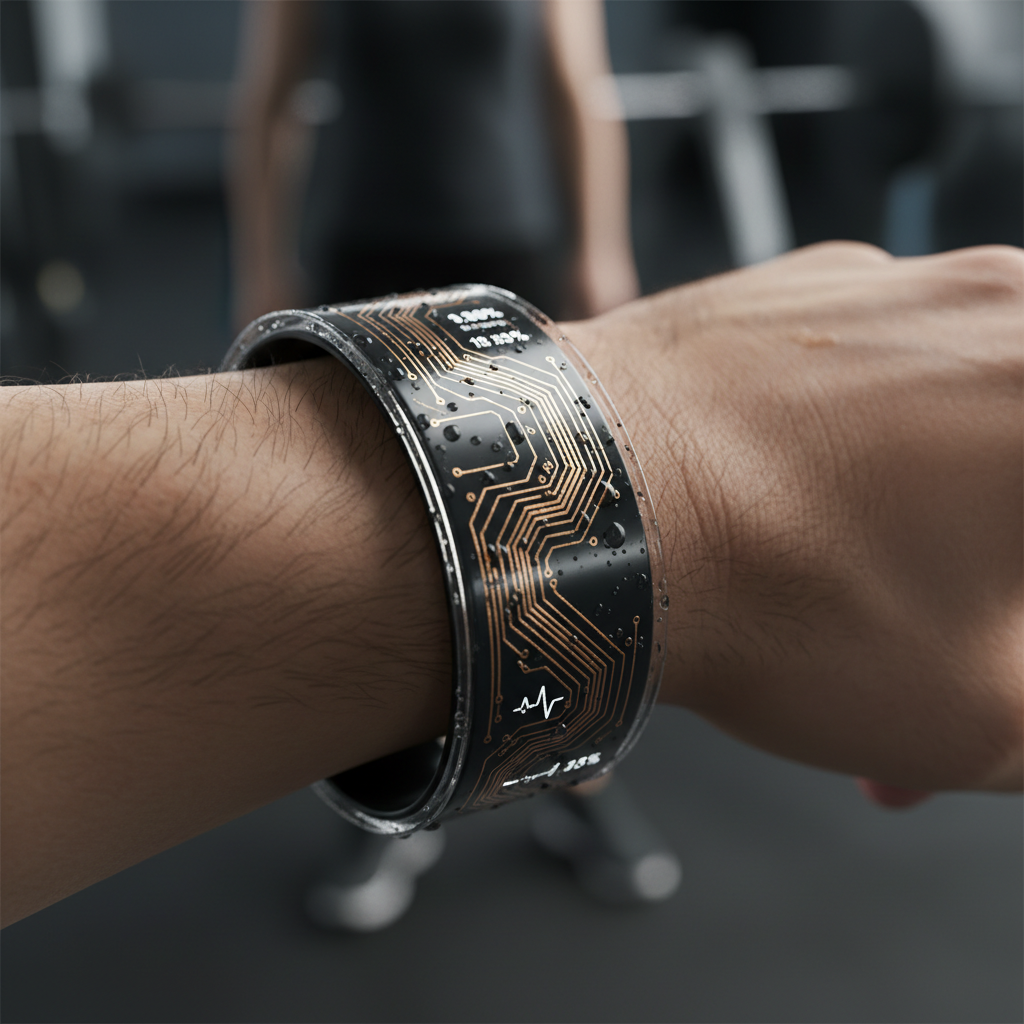
For engineers designing fitness trackers, these advantages translate into devices that users actually want to wear. A bulky, uncomfortable tracker gets left in a drawer. A lightweight, flexible device becomes part of daily life.
The Materials That Make Bending Possible
The secret to FPCB flexibility lies in the materials—understanding flex PCB materials is fundamental to creating reliable wearable devices. Unlike rigid PCBs that use fiberglass-reinforced epoxy, flexible circuits rely on specialized substrates that can bend repeatedly without cracking or losing electrical performance.
Polyimide (PI) serves as the gold standard substrate for most wearable FPCBs. This remarkable material maintains its properties across extreme temperature ranges—from -200°C to +400°C—making it ideal for manufacturing processes that involve high-temperature soldering. More importantly, polyimide offers an exceptional combination of flexibility and strength. It can bend to tight radii without breaking, yet remains dimensionally stable during assembly.
For cost-sensitive applications, Polyethylene Terephthalate (PET) provides an alternative. PET-based FPCBs cost less than polyimide circuits but have limitations—they can’t withstand soldering temperatures above 150°C and offer less long-term flexibility. Many basic fitness trackers use PET circuits where cost matters more than extreme durability.
Flex Plus has pioneered another breakthrough material for wearables: medical-grade Thermoplastic Polyurethane (TPU). Our TPU circuits offer unique advantages for devices that contact skin directly. They’re biocompatible, incredibly soft and comfortable, and can be manufactured as thin as 0.15mm. This innovation has enabled next-generation wearables that feel more like skin than electronics.
The conductive layer—typically copper foil—requires equal attention. Standard FPCB copper ranges from 18μm (½ oz) to 70μm (2 oz) thickness. Thinner copper bends more easily but carries less current. Thicker copper handles more power but reduces flexibility. Design engineers must balance these trade-offs based on the specific power requirements of sensors, displays, and wireless components.
The adhesive system matters too. High-quality FPCBs use adhesiveless construction where copper is directly bonded to the substrate, eliminating potential failure points. When adhesives are necessary, they must remain flexible across temperature extremes and resist degradation from sweat and body oils.
Designing Circuits That Bend Without Breaking
Creating a flexible circuit that survives real-world use requires understanding mechanical design principles that don’t apply to rigid boards. The most critical factor is the minimum bend radius—the tightest curve a circuit can handle without damage.
As a general rule, the minimum bend radius should be at least ten times the total circuit thickness. A 0.2mm thick FPCB shouldn’t bend tighter than a 2mm radius during installation. During dynamic flexing—when the circuit bends repeatedly during use—this minimum should increase to 20-30 times the thickness. Violating these guidelines causes copper traces to crack, leading to intermittent failures that are notoriously difficult to diagnose.
Strain relief zones protect circuits at critical connection points. These zones feature wider traces, curved corners instead of sharp angles, and sometimes stiffeners made from thin FR-4 material. Imagine the point where your fitness tracker’s display connects to the flexible circuit wrapping around the band—that junction experiences concentrated stress with every wrist movement. Proper strain relief distributes that stress over a larger area, preventing premature failure.
Many advanced wearables use rigid-flex configurations that combine flexible and rigid sections in a single circuit. The rigid sections provide mounting points for components like processors and batteries, while flexible sections enable bending. This approach eliminates traditional connectors—reducing weight, improving reliability by 87% through fewer interconnection points, and enabling more compact designs. At Flex Plus, our rigid-flex technology handles up to 12 layers, allowing complex wearable designs that would be impossible with purely flexible or purely rigid approaches.
Trace routing in flexible circuits requires special attention. ① Traces should run perpendicular to the bend axis whenever possible. ② When parallel traces are necessary, they should be staggered across different layers rather than aligned, reducing stress concentration. ③ Hatched ground planes flex better than solid copper pours, though they offer less EMI shielding—another trade-off engineers must carefully consider.
Keeping Power Flowing and Signals Clean
Wearable devices present unique electrical challenges. They run on tiny batteries, operate in electrically noisy environments (right next to your body, near other wireless devices), and must manage heat despite minimal space for cooling. FPCBs must address all these concerns while remaining flexible.
Controlled impedance matters tremendously for high-speed signals like those from cameras or displays. Even flexible circuits must maintain precise characteristic impedance—typically 50 ohms or 100 ohms differential—to prevent signal reflections that cause errors. This requires careful control of trace width, spacing, and substrate thickness. Flex Plus uses advanced impedance modeling to ensure our FPCBs meet specifications even when bent to their minimum radius.
EMI mitigation takes creative solutions in flexible circuits. Full ground planes aren’t always practical because they reduce flexibility. Instead, designers use hatched ground patterns, properly routed shield traces, and careful component placement to minimize electromagnetic interference. For fitness trackers with Bluetooth radios transmitting right next to sensitive biosensors, this becomes critical.
Power distribution requires thick enough traces to handle current without excessive voltage drop. A heart rate sensor might draw pulses of 50mA when its LED fires. Display backlights can pull 100mA or more. The resistance of copper traces in a flexible circuit can cause voltage drops that prevent proper operation if designers aren’t careful. We’ve seen prototypes where the display at the end of a long flexible circuit wouldn’t turn on because the traces couldn’t deliver enough current—a problem solved by widening power traces or using thicker copper.
Battery integration represents another challenge. Flexible lithium-polymer batteries can be directly integrated into the FPCB assembly, creating ultra-thin power solutions. However, battery swelling during charge cycles requires design accommodation—circuits must allow expansion without creating stress points that could cause failure.
Thermal management in flexible circuits requires creative thinking. Without the solid copper planes of rigid PCBs to spread heat, hot components like charging circuits or power management ICs can create localized hot spots. Flex Plus has developed breakthrough technology for flexible heat dissipation using thermal flow channels integrated directly into the FPCB structure. This proprietary approach reduces operating temperatures in high-power wearables, extending battery life and improving comfort.
Surviving Sweat, Water, and the Real World
A fitness tracker lives in a hostile environment. It endures sweat during workouts, exposure to chlorinated pool water, UV radiation from the sun, and temperature swings from air-conditioned offices to hot summer sidewalks. Environmental protection isn’t optional—it’s essential.
Waterproofing starts with the FPCB design itself. All exposed copper must be protected by soldermask or coverlay material. Connection points need sealed connectors or conformal coating to prevent moisture ingress. Many wearables achieve IP67 or IP68 ratings, meaning they survive temporary submersion. This requires not just protecting the FPCB, but ensuring the entire assembly—gaskets, enclosures, and interface points—forms a complete moisture barrier.
Sweat poses special challenges beyond simple water resistance. Human perspiration contains salts, acids, and other corrosive compounds that attack copper traces and solder joints. Proper protection requires conformal coatings specifically designed to resist these chemicals. At Flex Plus, our experience with medical-grade wearables has taught us which coating materials provide the longest protection against body chemistry.
UV resistance matters for outdoor fitness devices. Polyimide naturally resists UV degradation better than PET, one reason why premium fitness trackers use PI-based FPCBs. The soldermask and coverlay materials must also resist UV-induced breakdown that can lead to discoloration and eventual failure.
Biocompatibility becomes critical for devices in continuous skin contact. Not all materials are suitable for prolonged human wear. Medical-grade polyimide, proper soldermask selection, and careful choice of conformal coatings ensure devices won’t cause skin irritation during long-term use. Our TPU circuits meet ISO 13485 medical device standards, providing confidence for health-focused wearables.
Temperature cycling between hot gyms and cold winter mornings creates expansion and contraction stresses. Materials with different thermal expansion rates can delaminate or crack. Proper material selection and construction techniques—like adhesiveless bonding—minimize these failure modes.
Manufacturing Millions of Flexible Circuits
Designing a flexible circuit is one challenge. Manufacturing it at scale with consistent quality is another. Modern FPCB production combines traditional PCB processes with specialized techniques unique to flexible materials.
Panelization strategy significantly impacts production cost and yield. Flexible circuits can be manufactured using either sheet-by-sheet processing (similar to rigid PCBs) or roll-to-roll processing for high-volume production. Roll-to-roll offers lower costs for long, repetitive designs like those in some fitness tracker bands. Sheet processing provides more flexibility for mixed production and quick-turn prototyping.
Laser routing has revolutionized FPCB manufacturing, particularly for complex outlines and fine features. Traditional mechanical routing can distort thin flexible materials. Laser cutting provides clean, precise edges without mechanical stress. This matters especially for ultra-thin designs—Flex Plus manufactures circuits as thin as 25 microns where traditional routing would be impossible.
Through-hole plating in flexible circuits requires specialized processes because the materials behave differently than rigid FR-4 during plating. Proper barrel quality ensures reliable via connections that won’t crack during repeated flexing. At our facilities, we control plating parameters specifically optimized for flexible substrates, ensuring consistent via quality even in high-aspect-ratio designs.
Surface mount assembly on flexible circuits presents unique challenges. The flexible substrate doesn’t provide the dimensional stability of a rigid board during reflow soldering. Specialized fixtures hold the circuit flat during assembly. Temperature profiles must account for the different thermal properties of flexible materials. Our full PCBA services include fixtures and processes specifically designed for flexible circuit assembly, ensuring reliable component attachment even on ultra-thin substrates.
Stiffener attachment—adding rigid FR-4 sections for component mounting—requires precise alignment and bonding. These stiffeners must attach firmly enough to survive assembly forces yet not create stress concentrations that cause failure at flex-to-rigid transitions.
For wearables requiring Chip-on-Board (COB) integration—directly attaching bare semiconductor dice to the flexible circuit—Flex Plus offers industry-leading capabilities. Our die bonding precision maintains wafer offset angles within ±5°, exceeding standard industry tolerances. We’ve developed innovative magnetic fixture technology that solves the challenge of securing flexible substrates during COB assembly. This enables ultra-thin, high-functionality wearable designs impossible with packaged components.
Testing for a Lifetime of Bending
A fitness tracker might flex 10,000 times per month just from normal wrist movement. Over a two-year product lifetime, that’s 240,000 flex cycles. Ensuring reliability requires comprehensive testing that simulates years of use in days.
Repeated flex testing forms the cornerstone of FPCB reliability validation. Test fixtures repeatedly bend circuits through their expected range of motion while monitoring for electrical failures. At Flex Plus, we typically test to at least 100,000 cycles for consumer wearables—significantly exceeding typical product lifetimes. Medical wearables undergo even more rigorous testing, often 500,000 cycles or more.
These tests aren’t just pass/fail. Engineers monitor resistance changes throughout the test, identifying degradation trends that might indicate potential long-term failures. A circuit that shows steadily increasing resistance over 50,000 cycles might technically pass but indicates a design problem that needs correction.
Environmental exposure testing subjects circuits to temperature cycling, humidity exposure, and thermal shock. One common test cycles between -40°C and +85°C hundreds of times while the circuit is flexed, simulating extreme use conditions. Circuits that pass room-temperature flex testing sometimes fail these harsh environmental tests, revealing weaknesses in material selection or construction.
Salt fog testing simulates the corrosive effects of sweat and salt water. Circuits are exposed to controlled salt spray then tested for electrical performance. This identifies inadequate protection of copper traces and connection points that would lead to premature failure in real-world use.
Mechanical pull testing validates solder joints, connector attachments, and component bonds. Specifications typically require these connections to withstand forces 3-5 times higher than expected in normal use, providing safety margin against manufacturing variation.
For wearables with integrated batteries, charge-discharge cycling under flex conditions ensures the battery attachment and power connections remain reliable throughout the battery’s rated cycle life. This testing has revealed design issues with battery mounting that led to failures after just a few hundred charge cycles in early prototypes.
Partnering for Success in Wearable Design
Creating a successful wearable device requires more than just a flexible circuit—it demands a partnership between design engineers and manufacturing experts who understand the unique challenges of FPCB technology.
Starting with Design for Manufacturing (DFM) analysis saves time and money. Experienced manufacturers like Flex Plus review designs for potential manufacturing issues before prototype fabrication. This catches problems like traces too narrow for reliable production, bend radii that risk failure, or via placements that create stress concentrations. Early feedback prevents expensive redesigns after prototype testing.
Material consultation helps engineers select the right substrate for their application. Should you use polyimide or PET? Is TPU appropriate for your wearable? What copper weight balances flexibility with current-carrying capacity? These decisions impact cost, performance, and reliability. Manufacturers with 20+ years of experience have seen which choices work and which cause problems.
Rapid prototyping enables iterative design refinement. Standard prototype turnaround within one week—or three days for emergency requests—allows engineers to test, evaluate, and improve designs quickly. This speed matters tremendously in competitive consumer electronics markets where time-to-market often determines success.
The transition from prototype to volume production requires careful scaling. Processes that work for 10 prototype units sometimes fail at 10,000 units per month. Manufacturing partners with full in-house control—from raw materials to final inspection—provide consistency that brokers and trading companies cannot match. Direct communication with production engineers prevents the telephone-game effect where design intent gets lost between multiple intermediaries.
Full-service providers offering both FPCB fabrication and assembly simplify supply chains. Instead of coordinating between a circuit board manufacturer and a separate assembly house, single-source providers handle the entire process. This reduces lead times, minimizes quality issues from inter-vendor handoffs, and provides single-point accountability.
Certification compliance matters more than ever in wearable technology. Medical wearables require ISO 13485 certification. Automotive applications demand IATF 16949 compliance. Environmental responsibility requires ISO 14001 certification. Working with manufacturers holding these certifications ensures your product meets regulatory requirements without expensive re-qualification.
The Future Wrapped Around Your Wrist
The next generation of wearable technology will push FPCBs even further. Ultra-thin designs below 100 microns total thickness will enable wearables that feel like clothing rather than electronics. Stretchable circuits beyond merely flexible will conform to moving joints and expanding surfaces. Transparent FPCBs with 90%+ light transmission will integrate displays into clothing and accessories in ways we’re only beginning to imagine.
Bioelectronics will blur the line between electronics and human tissue. Sensors that monitor not just heart rate but blood chemistry, hydration levels, and early disease markers will require FPCBs with unprecedented biocompatibility and long-term reliability. Medical wearables will transition from consumer fitness accessories to serious healthcare devices preventing heart attacks and detecting cancer early.
Behind all these innovations lies fundamental FPCB technology—circuits that bend without breaking, enabling devices that improve lives without users noticing the complexity. Your fitness tracker survives thousands of daily bends because engineers carefully selected materials, designed for mechanical stress, protected against environmental damage, and validated reliability through rigorous testing.
Whether you’re developing the next breakthrough fitness tracker or a life-saving medical wearable, success requires partnering with FPCB manufacturers who understand not just how to make circuits flexible, but how to make them reliably flexible. With proper design principles, appropriate materials, and experienced manufacturing partners, your wearable technology can deliver the durability and performance that users expect.
The next time you check your fitness tracker, remember: that simple wrist movement represents thousands of engineering decisions working together, all enabled by a few layers of copper and polyimide that bend but refuse to break.