
Walk into any modern hospital, and you’ll find surgeons relying on minimally invasive cameras that bend through the body. Pull out your smartphone, and inside you’ll discover circuits that fold like origami to maximize every millimeter of space. Drive an electric vehicle, and flexible circuits are quietly managing power distribution in ways rigid boards never could. These aren’t futuristic concepts—they’re everyday realities made possible by flexible printed circuit boards.
For over two decades, we’ve watched flexible PCB technology transform from a specialized solution into the backbone of modern electronics. At Flex Plus, we’ve manufactured flexible circuits for everything from beauty tech gadgets to low-altitude drones, witnessing firsthand how this technology enables innovations that simply weren’t possible before. But what exactly are flexible PCBs, and why have they become so indispensable across industries ranging from consumer electronics to aerospace?
Understanding Flexible PCBs: More Than Just Bendable Boards
Unlike traditional rigid PCBs that use fiberglass substrates, flexible printed circuits are constructed on thin polymer materials—typically polyimide—that allow them to bend, fold, and twist while maintaining complete electrical connectivity. Think of the difference between a hardcover book and a magazine: both convey information, but one adapts to your hand while the other demands you adapt to it.
This fundamental construction difference opens possibilities that rigid boards simply cannot achieve. A flexible PCB can wrap around cylindrical components, fold into Z-configurations to save space, or dynamically flex millions of times in applications like laptop hinges or folding smartphones. The significance extends far beyond convenience—in medical implants, this flexibility can mean the difference between a device that works with the human body and one that fights against it.
The real breakthrough isn’t just that these circuits bend—it’s that they maintain signal integrity, thermal performance, and reliability while doing so. When we manufacture a flexible PCB for an AR wearable or an automotive sensor, we’re not compromising on electrical performance to gain mechanical flexibility. We’re delivering both.
Types of Flexible Circuits: Matching Technology to Application
Not all flexible circuits are created equal, and understanding the different types helps explain why they’ve found homes in such diverse industries.
Single-sided flex circuits represent the simplest form—one conductive copper layer on a flexible substrate. These are perfect for applications like LED lighting strips or simple interconnects where cost efficiency matters and electrical requirements are straightforward. We’ve manufactured single-sided flex circuits extending up to 1.6 meters for automotive harness applications, demonstrating that “simple” doesn’t mean limited.
Double-sided flex circuits add a second conductive layer, dramatically increasing routing density and enabling more complex designs. These commonly appear in smartphones, where engineers need to pack maximum functionality into minimal space. The challenge here isn’t just creating two layers—it’s ensuring reliable via connections between them while maintaining flexibility.
Multilayer flex circuits, ranging from three to eight layers, serve applications demanding high-density interconnects and complex routing. Medical devices requiring biocompatibility and aerospace systems requiring extreme reliability often specify multilayer flex. Each additional layer increases design complexity but unlocks capabilities that enable genuinely breakthrough products.
Perhaps most revolutionary are rigid-flex PCBs, which integrate flexible circuit sections with rigid boards in a single structure. Imagine a circuit board that’s rigid where you need component mounting and connector stability, but flexible where you need to fold it into a compact enclosure. This hybrid approach eliminates up to 87% of interconnection points compared to using separate rigid boards connected by cables, dramatically improving reliability while reducing size and weight by up to 60%.
We’ve seen rigid-flex technology transform product development in aerospace systems and military equipment, where every connection point represents a potential failure mode. By eliminating connectors between rigid sections, we’re not just saving space—we’re engineering out failure opportunities.
Materials Matter: The Building Blocks of Flexibility
The performance of any flexible PCB starts with material selection, and this is where engineering expertise separates adequate solutions from exceptional ones.
Polyimide serves as the primary substrate material for most flexible circuits, and for good reason. It maintains mechanical and electrical properties across temperature ranges from -200°C to +400°C, offers excellent chemical resistance, and provides the dimensional stability necessary for fine-pitch circuit patterns. When we manufacture flexible PCBs with minimum trace widths of 0.05mm, that dimensional stability becomes critical.
The conductor material—typically copper foil ranging from 18μm to 70μm thickness—must balance conductivity requirements with flexibility. Thinner copper bends more easily but carries less current. We guide customers through this trade-off based on their specific application: a wearable device might prioritize flexibility with 18μm copper, while an industrial control application might require 70μm copper for current-carrying capacity.
Adhesives represent an often-overlooked but crucial element. Traditional flexible circuits use adhesive layers to bond copper to polyimide substrates, but adhesiveless constructions offer superior performance in high-temperature applications and eliminate potential delamination issues. For applications involving repeated flexing or thermal cycling, adhesiveless laminates often prove worth their higher cost.
The choice between coverlay and soldermask affects both protection and flexibility. Coverlay—a layer of polyimide film with adhesive—provides excellent mechanical protection and maintains flexibility better than soldermask. However, soldermask offers finer feature resolution and simplified processing for certain designs. We regularly consult with customers on this choice based on their bend radius requirements and environmental conditions.
Stiffeners deserve special mention because they solve a common challenge: how do you connect components or connectors to something that bends? Stiffeners—rigid sections laminated to specific areas—provide stability where needed without compromising overall flexibility. Applications from aerospace systems to consumer electronics rely on strategically placed stiffeners for reliable component mounting.
Finally, surface finishes like ENIG (Electroless Nickel Immersion Gold) or OSP (Organic Solderability Preservative) protect copper traces while maintaining solderability. For medical devices requiring long-term biocompatibility, or aerospace applications demanding corrosion resistance, surface finish selection becomes critical.
Applications Across Industries: Where Flexibility Enables Innovation
The real story of flexible PCBs isn’t told in specifications—it’s told in the devices they enable.
In smartphones and wearables, flexible circuits make it possible to pack cameras, batteries, processors, and antennas into devices we carry without thinking. That folding smartphone in your pocket? It contains flexible circuits that flex hundreds of thousands of times without failure. Smartwatches and fitness trackers rely on flexible circuits that conform to curved cases while surviving the sweat, impacts, and temperature variations of daily wear.
Medical devices represent perhaps the most demanding application environment. We’ve manufactured flexible circuits for minimally invasive surgical tools that must maintain signal integrity while bending through the human body. Implantable devices require biocompatible materials and reliability measured in decades, not years. The ultra-thin flexible PCBs we produce—down to 25 microns with gold plating—enable medical devices that simply couldn’t exist with rigid alternatives.
In automotive applications, particularly electric vehicles, flexible circuits are revolutionizing power management and sensor integration. Battery management systems use flexible circuits to monitor hundreds of cells while conforming to curved battery pack geometries. Our automotive customers specify IATF 16949 certification because they understand that quality in automotive applications isn’t negotiable—lives depend on it.
Aerospace and defense applications push flexible circuit technology to its limits. These circuits must survive extreme temperatures, vibration, and radiation while maintaining perfect reliability. When we manufacture flexible circuits for aerospace customers, we’re not just meeting specifications—we’re engineering solutions for environments where replacement isn’t an option.
The emerging field of low-altitude airspace—drones, eVTOL vehicles, air taxis—represents an exciting frontier. These applications demand the weight savings of flexible circuits but with the reliability standards of aerospace. It’s exactly the kind of challenge that drives innovation in flexible PCB technology.
Manufacturing Excellence: From Design to Delivery
Understanding how flexible PCBs are manufactured reveals why direct manufacturer relationships matter so much.
The process begins with design and layout, where engineers must consider not just electrical requirements but mechanical constraints. Bend radius, trace placement in flex zones, and strain relief all factor into designs that will perform reliably in the real world. We provide comprehensive DFM (Design for Manufacturing) support because catching potential issues before production saves our customers weeks of iteration time.
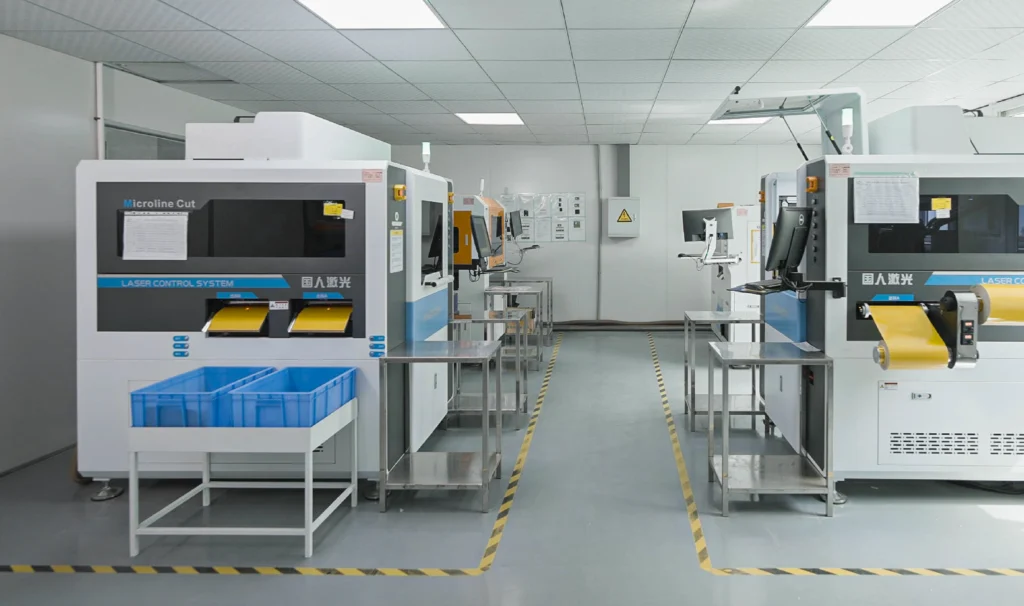
Material preparation involves cutting polyimide substrates and copper foils to precise dimensions. For our roll-to-roll processing capabilities—handling circuits up to 4 meters long—material handling and registration become critical precision operations.
Photolithography and etching create the circuit patterns. Photoresist is applied, exposed through photomasks, developed to create the circuit pattern, and then the unwanted copper is etched away. When you’re working with 0.05mm trace widths, this process demands cleanroom environments and precise control of every chemical bath and exposure time.
Via formation in multilayer constructions requires laser drilling or mechanical drilling, followed by electroplating to create electrical connections between layers. The challenge intensifies in rigid-flex designs where you’re drilling through materials with different properties and must maintain registration across rigid and flexible sections.
Coverlay or soldermask application protects the finished circuits, followed by surface finish application and electrical testing. Our state-of-the-art 16,000+ square meter facility maintains full in-house control over every step, eliminating the quality inconsistencies that can occur when working with brokers who outsource production.
Design Considerations: Engineering for Flexibility
Successful flexible PCB designs require understanding mechanical constraints as deeply as electrical requirements.
Minimum bend radius represents perhaps the most critical mechanical parameter. Bend a flexible circuit too sharply, and you’ll crack copper traces or delaminate layers. The general rule—minimum bend radius should be at least ten times the total circuit thickness—provides a starting point, but dynamic flexing applications require more conservative designs. We’ve manufactured flexible circuits that survive millions of flex cycles because we engineer appropriate bend radii from the start.
Trace placement and orientation dramatically affect reliability in flex zones. Traces running perpendicular to the bend axis experience less strain than those running parallel. Staggering traces across different layers, using curved rather than angular trace routing, and maintaining appropriate spacing all contribute to designs that survive real-world use.
Copper thickness selection involves balancing current-carrying requirements against flexibility needs. Thinner copper bends more easily but limits current capacity and increases resistance. Dynamic flex applications might specify 18μm copper even if thicker copper would be electrically preferable, because mechanical reliability takes priority.
Thermal management deserves careful attention because flexible substrates like polyimide don’t conduct heat as effectively as the FR-4 used in rigid boards. High-power components may require thermal vias, copper balancing, or even our proprietary flexible heat dissipation flow channels—a breakthrough technology we’ve developed for applications where thermal performance determines device viability.
Industry standards like IPC-2223 (Flexible Printed Boards) and IPC-6013 (Qualification and Performance Specification for Flexible Printed Boards) provide essential guidelines. These aren’t bureaucratic requirements—they’re distilled wisdom from decades of flexible PCB manufacturing experience. Our adherence to these standards, backed by ISO 9001, ISO 13485, and IATF 16949 certifications, ensures customers receive circuits engineered to perform.
Advantages and Trade-offs: Making Informed Decisions
Flexible PCBs offer compelling advantages, but understanding their limitations ensures appropriate application.
Space and weight savings represent perhaps the most obvious benefit. By eliminating connectors and cables, flexible circuits can reduce overall system weight by up to 60% compared to rigid board assemblies. For aerospace applications or wearable devices, this isn’t just convenient—it’s enabling.
Improved reliability comes from reducing interconnection points. Each connector or cable represents a potential failure mode. Our rigid-flex designs eliminate up to 87% of these connection points, directly translating to higher system reliability. In medical devices or military equipment, this reliability advantage justifies premium costs.
Enhanced durability in vibration and shock environments makes flexible circuits ideal for automotive and aerospace applications. Unlike rigid boards that can crack or break under mechanical stress, flexible circuits absorb and distribute forces.
However, flexible PCBs aren’t universally superior. Higher initial costs compared to simple rigid boards can be significant, though total system costs often favor flexible solutions when you account for eliminated connectors and reduced assembly complexity. Component density limitations mean that extremely complex designs with hundreds of components might still require rigid boards. Assembly challenges require specialized equipment and expertise—another reason why partnering with an experienced manufacturer matters.
Innovation Through Partnership: The Flex Plus Difference
After more than twenty years manufacturing flexible and rigid-flex circuits, we’ve learned that true innovation happens at the intersection of customer vision and manufacturing expertise.
Our ISO 9001, ISO 13485, IATF 16949, and ISO 14001 certifications aren’t wall decorations—they’re commitments to consistent quality and environmental responsibility. When an automotive customer needs IATF 16949-certified circuits or a medical device company requires ISO 13485 compliance, they’re not just checking boxes. They’re ensuring their products meet the stringent standards their industries demand.
Our investment in breakthrough technologies—from ultra-thin 25-micron designs to flexible COB integration, TPU circuits for medical applications, and proprietary thermal management solutions—reflects our belief that manufacturing excellence means continually pushing boundaries. We don’t just follow industry trends; we help create them.
The 16,000+ square meter facility we operate isn’t about impressive numbers—it’s about maintaining complete control from raw materials to final inspection. When customers communicate directly with our production engineers rather than through broker intermediaries, we catch design issues earlier, optimize manufacturability faster, and deliver solutions that work the first time.
From rapid prototyping in three days to volume production serving customers across North America, Europe, Asia, and beyond, we’ve built our reputation on one simple principle: your innovation deserves a manufacturing partner who brings the same commitment to excellence that you bring to your designs.
Whether you’re developing the next generation of wearable medical devices, designing automotive systems for electric vehicles, or creating aerospace solutions for emerging low-altitude applications, flexible PCB technology offers capabilities that rigid boards simply cannot match. The question isn’t whether flexible circuits can power modern electronics—they already do, in applications from the smartphone in your pocket to the medical devices saving lives every day. The real question is how your next innovation will leverage the unique advantages flexible circuits provide.